Translated with AI from the Russian original.
The operation of Russia's northwestern ports has effectively been paralyzed. Rapid ice growth and a shortage of icebreakers have created an export collapse for metal products and fertilizers.
The situation is being aggravated not only by unfavorable weather conditions, but also by mandatory diver inspections of vessels.
Since February 16, in the Big Port of St. Petersburg, vessels without ice reinforcement may sail only with individual escort. From February 19, if ice thickness exceeds 30 centimeters, such vessels will not be allowed to sail at all. And vessels of ice classes Ice1 and Ice2 (operating at ice thickness from 0.4 to 0.55 m) will require an icebreaker.
Similar restrictions have also been introduced in Ust-Luga. In conditions of an acute shortage of icebreakers, escorting one vessel can take up to 12 hours.
An additional problem is the impossibility of carrying out mandatory diver inspections of vessels, since in dense compact ice near Gogland Island divers cannot work. Under ice cover conditions, the inspection procedure in the Baltic takes more than 11 hours.
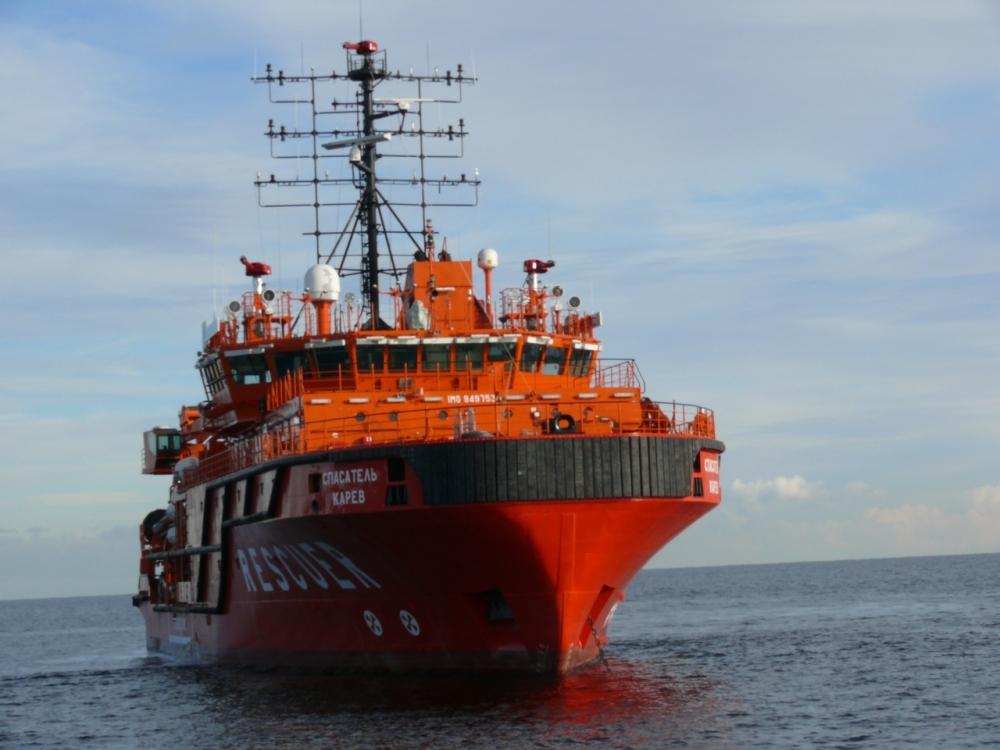
The Ministry of Transport has already deployed the vessel \"Spasatel Karev\" of project MPSV07 to the ports, and on February 19 the icebreaker \"Murmansk\" (a linear diesel-electric vessel of project 21900M) is expected to enter the Gulf of Finland. Rosatom has also requested a nuclear icebreaker. The agency is considering the possibility of individually assessing ice passability for low ice-class vessels, which would allow them to enter ports without strict restrictions.
Similar ice conditions in the Baltic were observed in the winter of 2010–2011. At that time, ice thickness in the Gulf of Finland reached 70 cm.
Earlier, www1.ru reported that Russia may save the most powerful German icebreaker stranded in the Arctic.
Read more materials on the topic:
- \"Spasatel Karev\" refloated the bulk carrier \"Megna Princess\" in the Gulf of Finland
- The new 18 MW icebreaker \"Vyborg\" will enter service in 2028
- A diesel-electric icebreaker of project 21900M2 is being built in Vyborg
Never miss our newsAdd this site to your preferred sources to see us more oftenAdd on Google

















