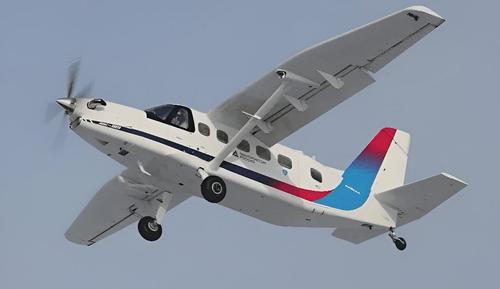
Certification tests of the AV-901 propeller for the "Baikal" light aircraft have started, according to the Ural Civil Aviation Plant (UZGA).
Andrey Dobryakov, Deputy Head of Rosaviatsiya, and Viktor Priimak, Head of "Aviaregistr Rossii," an enterprise subordinate to the agency, visited one of UZGA's production sites in Moscow.
They checked the progress of the AV-901 propeller tests and inspected the testing laboratory and stands. The tests are carried out according to the program of static and fatigue tests of propeller elements approved by "Aviaregistr Rossii" in accordance with FAR requirements, the company emphasized.
Experts from certification centers, as part of the working group approved by the agency, are participating in the tests. The propeller is entirely made of domestic materials. To date, there are no analogues to this propeller in Russia, UZGA emphasized.
Russian Prime Minister Mikhail Mishustin stated that the LMS-901 "Baikal" aircraft should be ready for mass productionno later than the end of 2026.
Earlier, www1.ru reported that China will not take off without the PD-35: it has no other engine for the wide-body C-929.
Read more on the topic:
Millions were given for the old aircraft engines of military aircraft AL-21 and AI-25 TL
A millionth titanium ingot for the construction of MS-21 and SJ-100 was smelted in Russia
The project of a new wide-body Russian aircraft was shown in the photo: better than the Boeing 787-9 Dreamliner
Never miss our newsAdd this site to your preferred sources to see us more oftenAdd on Google

















