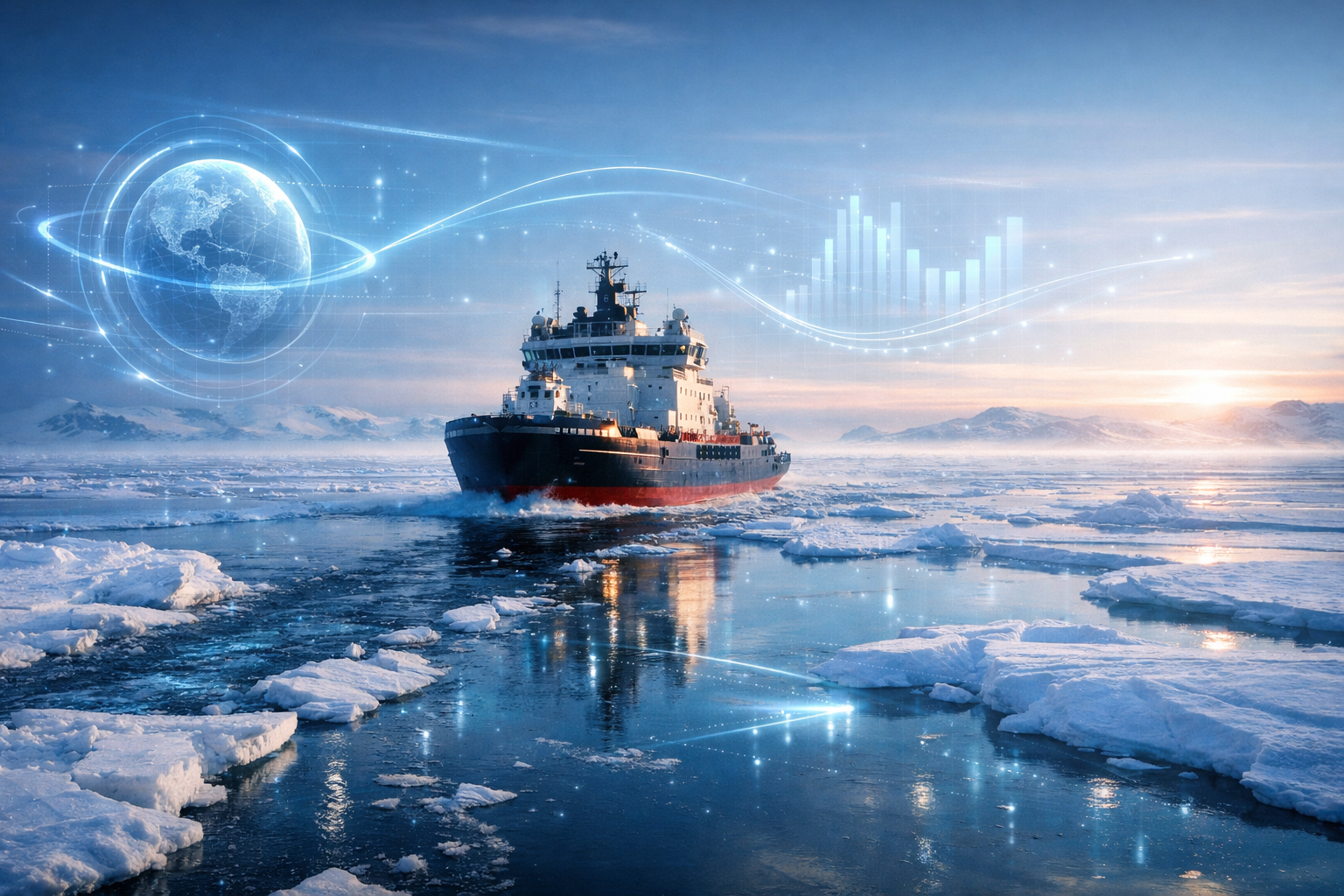
The Arctic and Antarctic Research Institute is completing the development of an environmental monitoring program for the Trans-Arctic transport corridor. AARI Director Alexander Makarov announced this in an interview with TASS. The finished document is planned to be presented by the summer of 2026. Makarov attributes the need for the program to a sharp increase in the load on the Arctic ecosystem: 38 million tons of cargo are currently transported along the Northern Sea Route (NSR) on large-capacity vessels, nuclear-powered ships, and gas carriers. There has never been such pressure on the natural environment before, the institute's director emphasized.
What the AARI Monitoring Program Includes
The program is based on four elements. The first is the adjustment of observations at stationary points of the Roshydromet network already deployed in the Arctic. The second is monitoring of port infrastructure. The third is ship-based incidental observations, which are planned to be systematized and brought to a unified format. The fourth is the collection and consolidation of all information, followed by its transfer to a unified platform of digital services of Rosatom, GIS monitoring, and information systems of the Ministry of Transport.
The program covers not only the physical parameters of the environment but also the impact on marine mammals, birds, plankton, and microorganisms. Arctic ecosystems are extremely sensitive: the consequences of any incident will be extremely difficult to eliminate, Makarov warns.
Navigation on the Northern Sea Route: Forecast Accuracy and Year-Round Corridor
In parallel, AARI is developing the "North" forecasting system for navigational support of the route. The accuracy of the institute's ice forecasts for navigational tasks exceeds 90%. The western sector—the Barents and Kara Seas—is already available for year-round navigation. The eastern sector—the Laptev, East Siberian, and Chukchi Seas—remains challenging: ice up to 1.5 m thick is recorded there, which has not been observed for about 20 years.
The Arctic seas do not forgive a frivolous attitude towards them. Today, the accuracy of our ice forecasts is very high—more than 90% specifically for navigational tasks.
Against the backdrop of disruptions in the Strait of Hormuz, Rosatom head Alexei Likhachev in March called the Northern Sea Route a "stable transport artery" and pointed to its security—both economic and political. This reinforces the strategic importance of AARI's work: the reliability of the route directly depends on the quality of ice forecasts and the state of the Arctic ecosystem.
Read more materials on the topic:
- Rosatom is negotiating with China and India on joint work on the Northern Sea Route
- New generation icebreaker for the Northern Sea Route began to be designed at USC
- Foreign companies are preparing to invest billions in the Russian Northern Sea Route
Never miss our newsAdd this site to your preferred sources to see us more oftenAdd on Google

















