Transmashholding revealed the reasons for using the gas-diesel cycle in the promising 3TE30 locomotive. Mikhail Rozhkov, Deputy General Director of TMH for Technical Development, spoke about this in an interview with the Gudok publication.
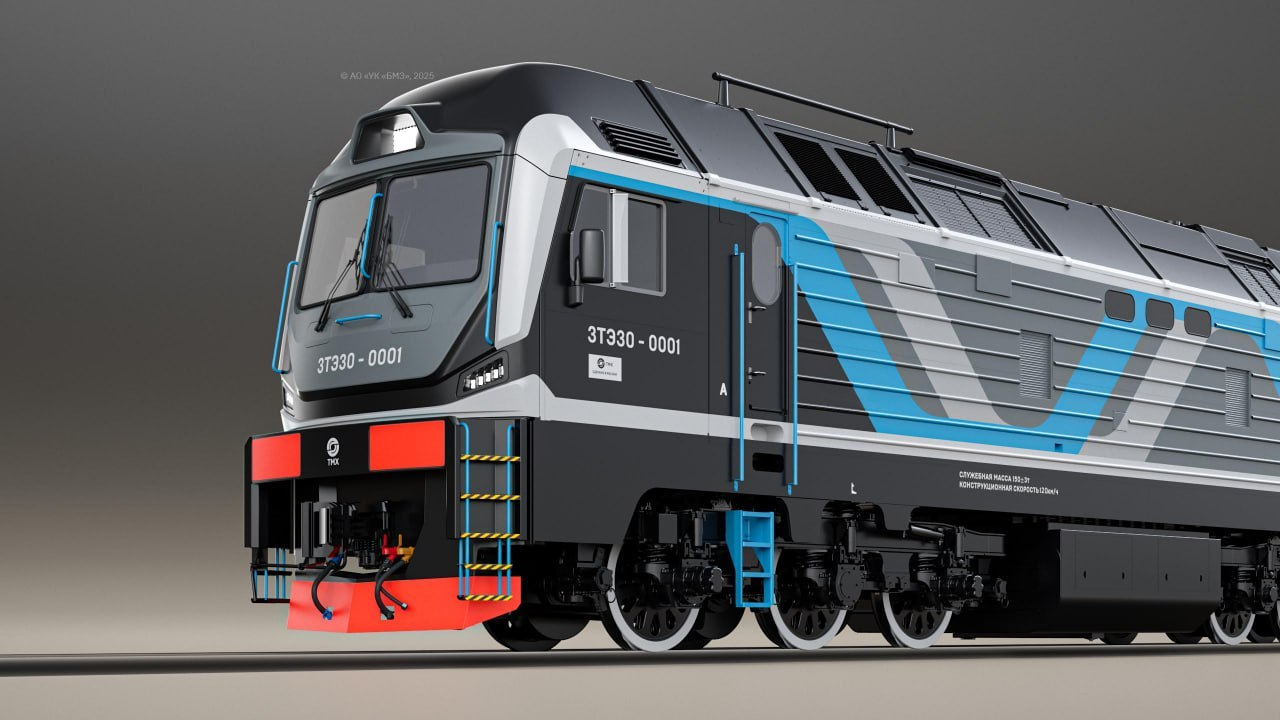
According to the top manager, a complete transfer of the diesel locomotive engine to gas leads to a loss of up to 20% of power, which is critical when starting heavy trains. Therefore, the engineers chose a combined scheme: the train accelerates on diesel fuel, and the transition to cruising speed occurs on natural gas. This is exactly how the 3TE30 will work.
Rozhkov emphasized that gas performance is especially beneficial in cold regions. Liquefied natural gas does not thicken in the cold, unlike diesel fuel, which increases the reliability of the locomotive in the Far North. Power losses and changes in the mass of the train are compensated by the stability of the power plant.
The new generation dual-fuel locomotive was developed by a subsidiary of TMH Engineering. A prototype 3TE30 is already being manufactured at the Bryansk Machine-Building Plant. The machine was created for a specific task — driving trains weighing up to 7,100 tons on the Baikal-Amur Mainline.
The power plant is based on a new 16-cylinder gas diesel generator 16GDG with a nominal power of up to 3600 kW. The locomotive will receive GTSN-3150 synchronous generators and asynchronous traction electric motors. The head sections are made according to a six-axle scheme, and the booster section with a cryogenic tank for LNG is made according to a four-axle scheme.
Read more on the topic:
Never miss our newsAdd this site to your preferred sources to see us more oftenAdd on Google

















