Scientists from the Kola Science Centre (KSC) of the Russian Academy of Sciences and the St. Petersburg State Technological Institute (SPbGTI TU) have synthesized ceramic solid solutions based on erbium niobates-tantalates. The material combines luminescence with the up-conversion effect, bactericidal properties, and mechanical strength exceeding some steel grades. The study was published in the journal Ceramics, according to the press service of the Ministry of Education and Science of the Russian Federation.
How the material is obtained
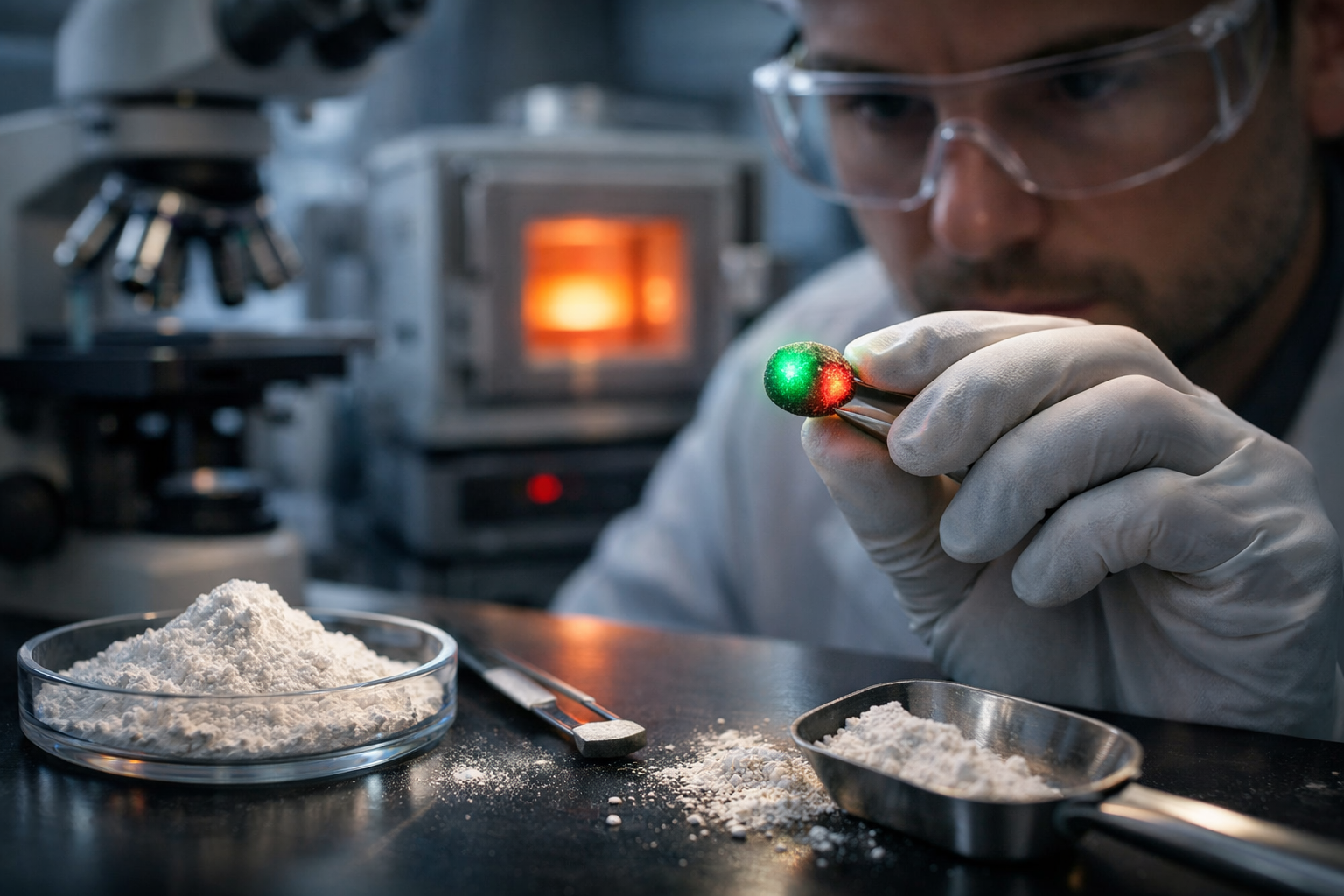
For the synthesis of samples, a liquid-phase method was used: hydroxides were precipitated from solutions, then sintered in a furnace at 1400°C. Unlike conventional phosphors, which absorb energy and emit light with less energy, the new ceramic works "in reverse" — it absorbs infrared radiation (e.g., a laser with a wavelength of 980 nm) and converts it into visible green or red light.
Scientists have found that an equal ratio of niobium and tantalum in the composition creates a synergistic effect: the intensity of luminescence in the visible region exceeded the values of pure erbium niobate or pure erbium tantalate. This opens the way to ultra-sensitive optical temperature sensors.
Bactericidal action and strength
ErNbO₄ powder was tested on three types of microorganisms: gram-positive, gram-negative, and spore-forming bacteria. Under the action of ordinary daylight, the ceramic destroyed up to 90% of the population. In the dark, the effect was halved — about half of the bacteria survived.
Pure erbium niobate and samples with a small addition of tantalum showed the best strength performance, surpassing some steel grades. Such ceramics are suitable for the manufacture of sensors and meters operating under high mechanical loads.
Where the development will be applied
The authors of the study identified several areas:
- production of lasers, LEDs, and optical amplifiers for communication systems;
- medicine — contrast agents for bioimaging (visualization of processes inside the body) and photodynamic therapy of infections;
- filter coatings for water and wastewater treatment — sterilization of the environment under the action of light;
- non-contact thermometers for aggressive environments where conventional electronics fail.
The synergy of an equal ratio of niobium and tantalum allowed for the first time to combine in one material up-conversion luminescence, high mechanical strength (higher than some steels), and photo-induced bactericidal activity (killing 90% of bacteria in light).
This kind of ceramic solves several problems at once: it allows creating non-contact optical sensors for aggressive environments, effective photodynamic therapeutic agents, and coatings for self-sterilizing water purification systems — without the use of additional chemistry or ultraviolet light.
Read more materials on the topic:
- Breakthrough in aircraft engines: Russia created ceramics that can withstand 2000°C
- Ceramics with controlled electrical resistance developed by scientists from the SSC RAS, DSTU, and SFU
- New generation ceramics for aircraft engines: TPU developed a coating that can withstand 1100 °C and does not oxidize
Never miss our newsAdd this site to your preferred sources to see us more oftenAdd on Google









![Growth Point: After 5G Launch, Mobile Internet in Russia Accelerated by 20%","subtitle":"TelecomDaily recorded an upload speed increase of 19.7%, and download speed of almost 14%","announce":""}[]}],](https://media.ixbt.site/fit-in/320x/ixbt-data/1727896/ai-image-nvgq0a0v5cjnyxwoc8xpelva.webp)