Russian scientists have created an electrolyte for batteries that can operate at extremely low temperatures — down to minus 60 °C. The development was presented by Rosatom specialists. According to researchers, the new solution successfully passed preliminary tests and even showed a slight superiority over existing foreign analogues. Details were disclosed by the press service of TVEL — Rosatom's fuel division.
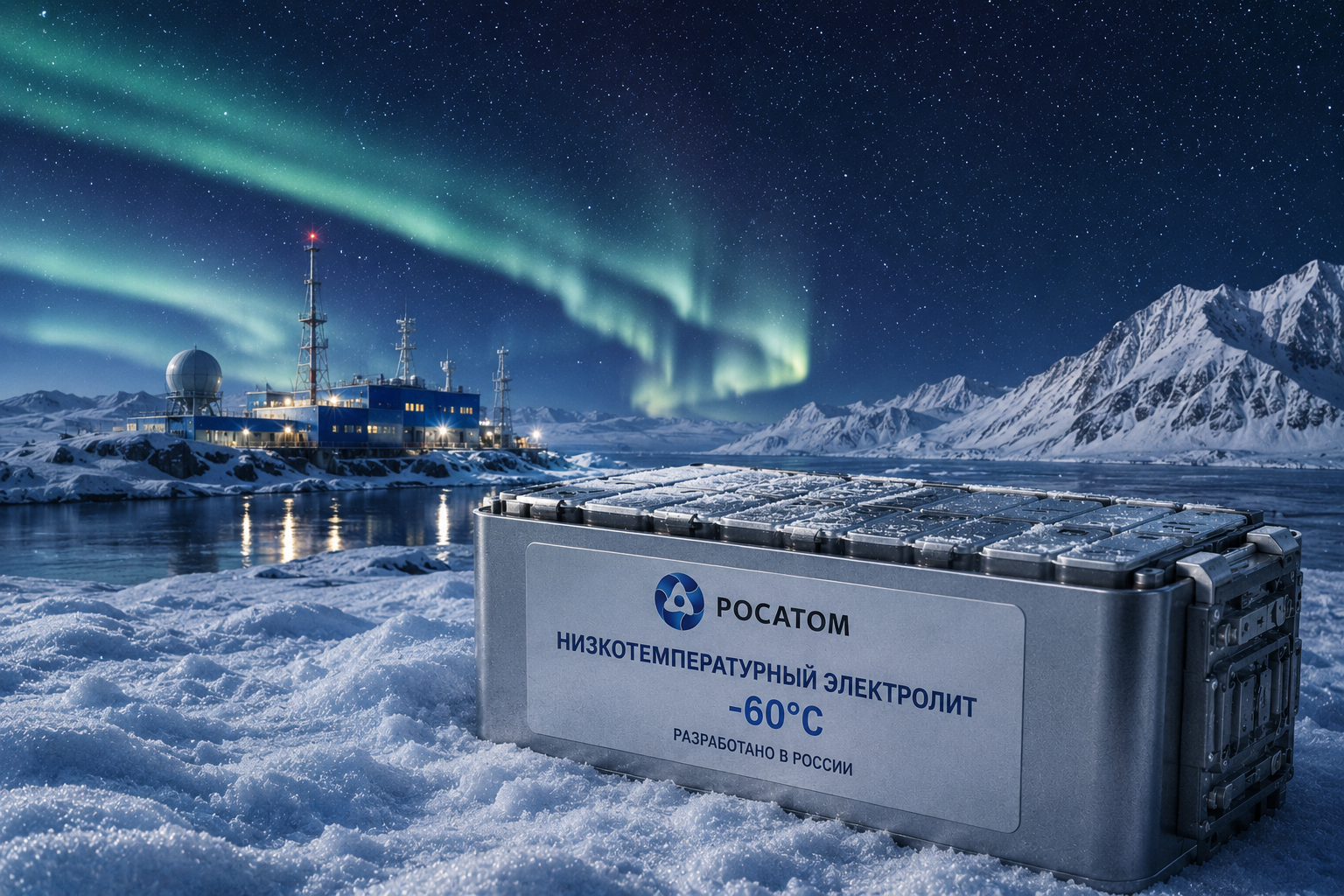
This refers to a special electrolyte — a liquid that is inside the battery and helps lithium ions move between battery elements. It is thanks to this that the battery can be repeatedly charged and discharged. The battery's capacity, power, service life, and safety directly depend on the properties of the electrolyte.
The main problem with ordinary batteries in severe frost is that the electrolyte begins to thicken. In essence, it becomes viscous almost like honey. Because of this, the resistance inside the battery sharply increases, the voltage drops, and the battery begins to quickly lose efficiency.
However, the new composition developed in Russia turned out to be weakly sensitive to supercooling. Thanks to this, battery cells based on it lose a maximum of about 30% of their total energy capacity even at a temperature of minus 60 °C compared to operation at room temperature.
The technology can become the basis for the production of batteries in Russia suitable for operation in the Arctic, at polar facilities, and even on space stations, where ordinary power sources quickly lose efficiency due to extreme cold.
Currently, the state corporation is working with industrial partners to produce a serial batch of battery cells with the new electrolyte.
Read more on the topic:
- Following the Chinese: Novosibirsk scientists learned how to extend the service life of electric vehicle batteries
- Now the cold won't kill the battery: TPU scientists, together with colleagues from China, have created a storage device for extreme conditions
- Submarines to get titanium batteries: Gazprom creates submersible accumulator
Never miss our newsAdd this site to your preferred sources to see us more oftenAdd on Google

















