The wheeled all-terrain vehicle Burlak and the tracked Vityaz DT-30 were tested working together. This was reported by the press service of OOO "Vezdekhody Burlak".
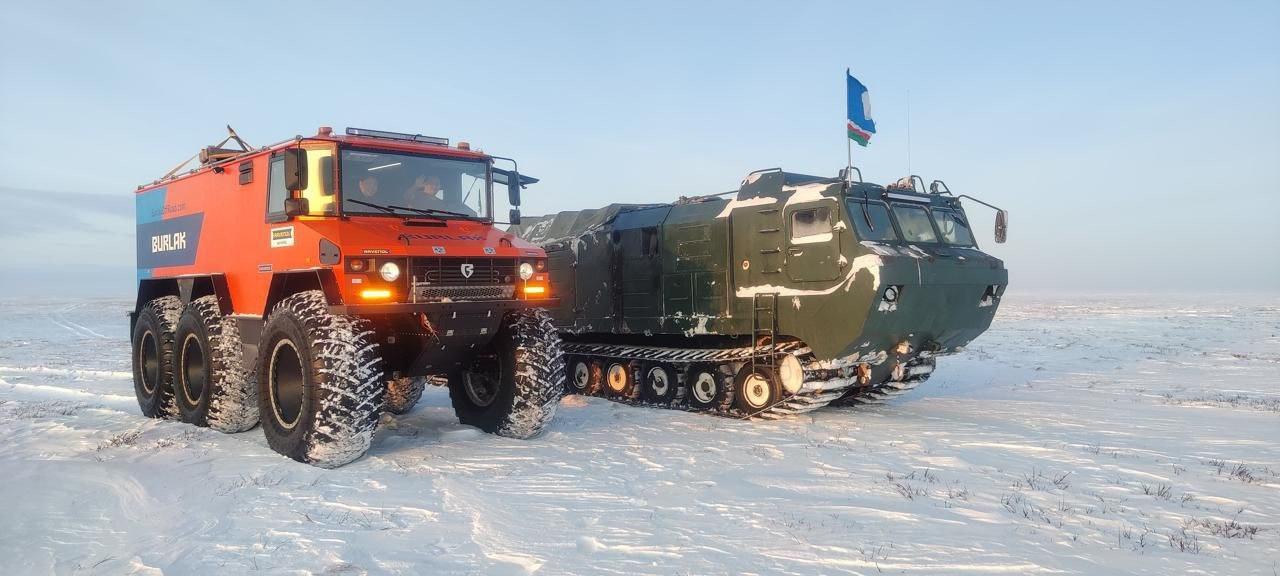
Both vehicles are used in Yamal. The all-terrain vehicles are employed for laying communication lines and carrying out other work in difficult climatic conditions.
The Burlak goes out onto the winter road earlier than other all-terrain vehicles and makes it possible to work during the transitional seasons.
The all-terrain vehicle is used as a motorhome and for travel on public roads. It provides a high level of comfort for the crew.
The Vityaz DT-30 is used to transport heavy equipment, materials, and cargo to the work site. Working together, both vehicles demonstrated high efficiency and indispensability in northern conditions.
Technical specifications of the Burlak all-terrain vehicle:
- Length — 7,380 mm
- Width — 2,900 mm
- Height — 3,200 mm
- Ground clearance — from 700 to 750 mm
- Curb weight — 4 t
- Payload capacity on firm ground — up to 2,000 kg, on weak-bearing ground — up to 1,000 kg
- Maximum speed: on land — 80 km/h, on water — 6 km/h
- Transmission — 5-speed, manual
- Engine power — 150 hp
Technical specifications of the tracked all-terrain vehicle Vityaz DT-30:
- Maximum length of transported cargo — 13 meters
- Speed afloat — 5 km/h (with an installed propeller — up to 15 km/h)
- Ford depth for non-amphibious models — 1.8 meters
- Curb weight — 28 t
- Payload capacity — 30 t
- Maximum speed on land — 37 km/h
- Fuel range — 500 km
- Transmission — hydromechanical semi-automatic
- Engine power — 710 hp
Earlier, www1.ru reported that the payload capacity of Burlak all-terrain vehicles was increased by 60% — to 2.5 tonnes.
Read more materials on the topic:
- A 6-wheeled all-terrain vehicle called Bro was created in Russia for 16.5 million rubles
- Developers from St. Petersburg unveiled Karakurt-1, an all-terrain vehicle with Russian roots
- "Shishiga from the future": the tracked all-terrain vehicle R-41 was presented in the Moscow Region
Never miss our newsAdd this site to your preferred sources to see us more oftenAdd on Google













![Growth Point: After 5G Launch, Mobile Internet in Russia Accelerated by 20%","subtitle":"TelecomDaily recorded an upload speed increase of 19.7%, and download speed of almost 14%","announce":""}[]}],](https://media.ixbt.site/fit-in/320x/ixbt-data/1727896/ai-image-nvgq0a0v5cjnyxwoc8xpelva.webp)