Roscosmos reported on what 2023 was like for Russian cosmonautics. The agency recalled that it had conducted nineteen launches of space launch vehicles during the year, and continued the record series of accident-free launches, which began in 2018, with one hundred and seventeen starts in the series. Some of the launches were for scientific purposes, some - in the interests of the Ministry of Defense.

Perviy Tehnicheskiy, together with Roscosmos, recalled the most striking events of the outgoing year for Russian cosmonautics and Russian satellite construction that you might have missed.
Presentation of the Russian Orbital Station
In June, the Energia Rocket and Space Corporation completed the preliminary design of the Russian Orbital Station. It will be larger than the ISS and will eventually replace it not only for Russian cosmonauts, but also for astronauts and cosmonauts from other countries. In October, following a meeting with President Vladimir Putin, it was instructed to approve a federal project to create the station.
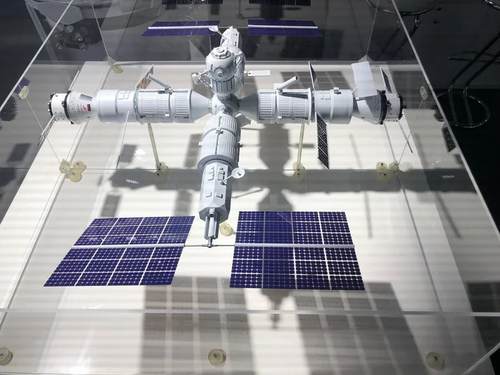
At Dubai Airshow 2023, Russia showed what the Russian Orbital Station and its commercial modules will look like, and what will be inside the station and commercial modules.
The station's first scientific and energy module will go into orbit as early as the end of 2027, and the ROS will be fully formed by 2032.
New start for Russia's lunar program
Russia has revived the program to study the Moon, which had been completely forgotten after the collapse of the USSR. And finally, in 2023, for the first time in almost fifty years, a domestic spacecraft was sent from Russia to the Moon to study the Earth's satellite.
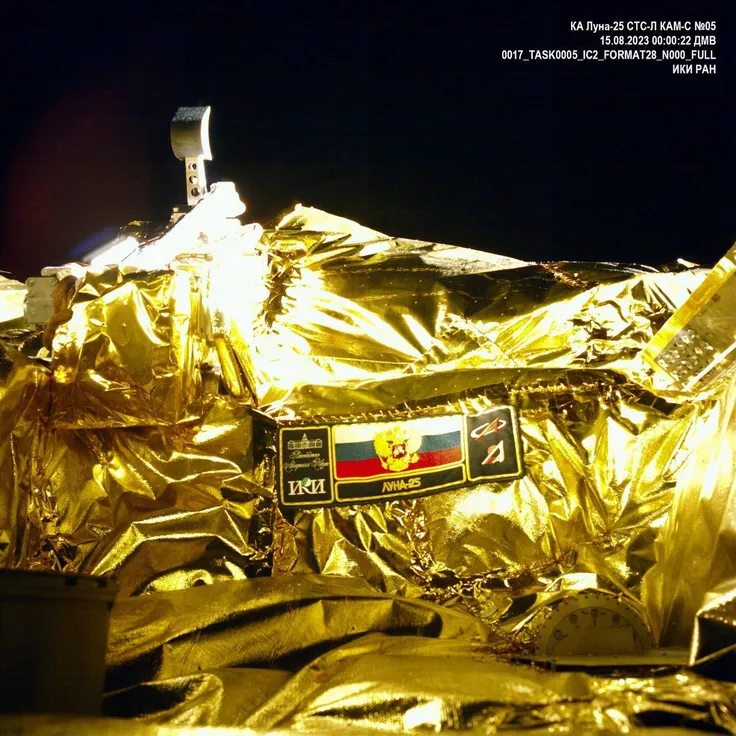
Unfortunately, the Luna-25 automatic station crashed without ever landing. A special commission investigated the incident. According to the results of its work, it became known that the new domestic Bius-L unit for measuring angular velocities, which is part of the station's onboard control complex, was to blame for the accident.
The device was designed at the N. A. Pilyugin Scientific and Production Center for Automation and Instrument Engineering (NPTSAP) from completely Russian parts. It was responsible for determining the station's orientation in space and its speed. Shortly before landing, the Bius-L's accelerometer units failed due to a possible "entry into one data array of commands with different priorities for their execution by the device."
But Luna-25 still managed to contribute to science. It took pictures from space and took measurements of the radiation background. Also, after entering the orbit of an artificial satellite of the Moon, the station photographed the southern polar crater Zeeman on the far side of the Moon, measured the fluxes of gamma rays and neutrons from the surface of the Moon, and obtained the parameters of the lunar space plasma and gas-dust exosphere in lunar orbit.
The state corporation took into account the negative experience. And they are already planning new launches, and the new Luna will have understudies.
Friendly countries to Russia are also joining in their space programs to explore the Earth's satellite. It became known that Russia, Belarus, China, the UAE and Pakistan will build a scientific station on the Moon together, with construction scheduled for 2031-2035.
Russia's plans for deep space exploration
In 2023, the M.V. Keldysh Research Center of the Russian Federation (part of the Roscosmos State Corporation) said that they are working on a new spacecraft for deep space flights.
It will help to make transport operations in space more economical, and will also provide a "significant increase in electrical power in space and the creation of spacecraft with variable orbital parameters."
Spacewalk after accident on the ISS
In the outgoing year, the world watched with bated breath as Russian cosmonauts Oleg Kononenko and Nikolai Chub went out into space in October and spent almost eight hours there.
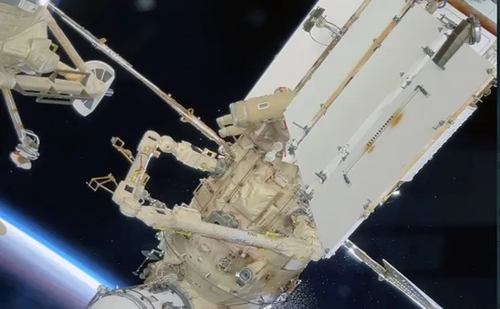
The coolant leak from the external radiator circuit and the investigation of the causes of the accident forced the National Aeronautics and Space Administration (NASA) to prohibit astronauts from going into space until the end of the year.
Roscosmos did not cancel the planned extravehicular activities for Chub and Kononenko. They carried out a unique and responsible mission: they reached the site of the hydraulic line break, inspected the site and took pictures to send to Earth. They also performed standard tasks related to spacewalking as planned.
Satellite boom
This year, Russia also did a lot for the Sphere project and for the emergence of a strong orbital constellation of satellites in Russia. This year, the orbital constellation was replenished with the second Arktika-M, the second and third Meteor-M, the fourth Elektro-L, and the Kondor-FKA.
Also, specialists began to assemble the first experimental Griffons for global Earth monitoring, made progress on the Marathon-IoT constellation of satellites for the Internet of Things - and talked about global satellite construction plans until 2030.
It is planned not only state, but also private participation in satellite construction and the creation of a market for commercial space services. It is assumed that at least 600 satellites out of more than one and a half thousand by 2030 will be commercial.
Reusable launch vehicles
The first Angara-A5 flight rocket was delivered to the Vostochny Cosmodrome at the end of the year, which will be sent into space after flight design tests. All actions with the rocket model have already been worked out, now it remains only to check the rocket itself - and launch it. Roscosmos considers this launch to be "a new page in the history of the Russian rocket and space industry".
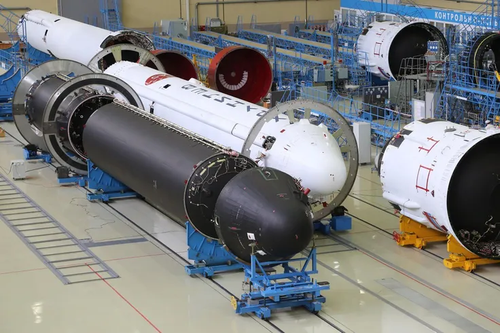
Thanks to the Angara rockets, Russia will be able to launch any spacecraft into space on its own. It is known that as part of the Amur space rocket complex with a returnable first stage in the East, it is planned to use three-stage heavy-class Angara-A5 and Angara-A5M launch vehicles. Full flight tests of Angara-A5 will be completed in 2024.
Russian scientists have also made progress in creating a single-stage reusable rocket "Korona".
Never miss our newsAdd this site to your preferred sources to see us more oftenAdd on Google