Researchers from the Faculty of Physics of Moscow State University, together with doctors from the Medical Scientific and Educational Institute and the Faculty of Fundamental Medicine, have for the first time in Russia successfully conducted an experiment on the non-contact destruction of a malignant tumor with ultrasound.
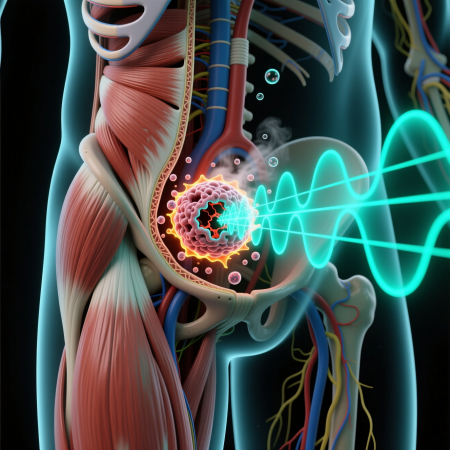
Scientists have for the first time demonstrated the ability of pulsed high-intensity focused ultrasound to mechanically destroy human leiomyosarcoma tissue without heating or incisions.
The experiment was carried out withleiomyosarcoma - an extremely aggressive tumor that develops from smooth muscle tissue, and one of the most common soft tissue sarcomas. Under the control of an ultrasound machine, scientists were able to destroy the tumor ex vivo ("outside the body"), turning the tissue into an unstructured liquid.
Histological analysis confirmed the complete destruction of tumor cells, while healthy tissue remained undamaged.
According to the project manager Vera Khokhlova, the method is based on focusing high-amplitude ultrasonic pulses on the pathological area through the skin and healthy tissues. The tumor is destroyed mechanically, due to non-linear acoustic waves with sharp pressure drops, and not by heating.
Scientists believe that the new technology could become an alternative to surgical and drug treatment of sarcomas, especially in cases where surgery is not possible.
Read more materials:
- Faces from the past: MSU Mummy acquires biometrics thanks to science
- MSU biosensor overcomes oxygen deficiency and increases measurement sensitivity by 100 times
- Russia and Arab countries will search for extraterrestrial life
Never miss our newsAdd this site to your preferred sources to see us more oftenAdd on Google

















