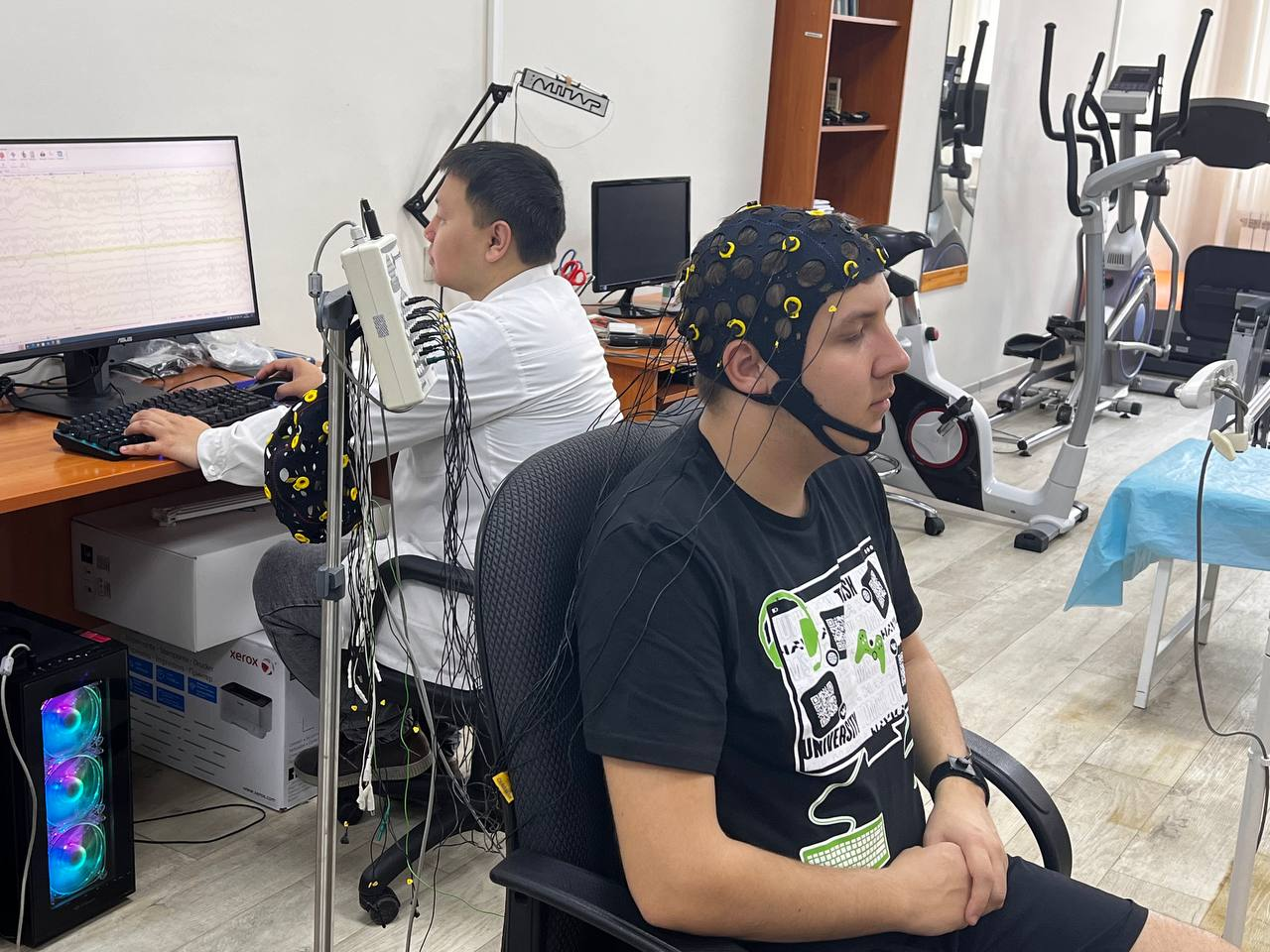
Researchers from the Faculty of Physical Culture of TSU, with the support of the Priority 2030 program, studied how online learning affects human physiology. The focus is on the work of the brain, the cardiovascular system, and cortisol levels. The experiments included passing tests in three formats: in person, through computer tests, and using ChatGPT. Volunteers wore sensors that recorded blood pressure, EEG, and hormonal background.
Initial results demonstrated the presence of physiological changes. In particular, this concerns the functioning of the cardiovascular system. In the process of communicating with the teacher, students experience more pronounced excitement and stress compared to computer testing.
At the same time, we saw that when taking a test online, the subjects have lower concentration, that is, they cannot quickly and clearly solve the problem. As studies show, and these results are confirmed in practice, online learning, including VR, has its drawbacks in addition to a large number of advantages.
The study confirmed that virtual skills are not always transferred to reality. For example, successful actions in a VR simulator do not guarantee a similar result without devices.
The most important disadvantage is that by performing any actions qualitatively in a virtual environment, a person cannot repeat them as effectively in real life. It's like being able to drive a car on a simulator, but being unable to do it on the road.
Two approaches are being tested to solve the problem:
- Phygital methodologies - synchronization of actions in real and digital environments. In a pilot project, students did aerobics in VR glasses, combining physical activity with visual stimuli
- Artificial collision - deliberate provocation of errors (for example, an incorrect answer on a test) to train cognitive flexibility
For example, during a test, at some stage, the student is asked to give a deliberately wrong answer. This is psychologically difficult. But after such an answer, a person must return to the correct line of thinking.
It is expected that an adaptive model for different specialties will be developed by the end of 2025.
Read more materials on the topic:
Digital habits of older people: MIPT study refutes stereotypes about elderly smartphone users