Specialists will begin the second stage of the experiment on growing semiconductors on board the International Space Station (ISS) using the "Ekran-M" installation in 2026. This was announced by the head of the Siberian Branch of the Russian Academy of Sciences (SB RAS), Valentin Parmon.
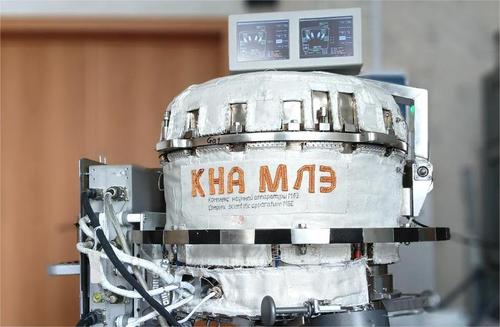
A sample of the first Russian installation for the synthesis of semiconductors in space was sent to the ISS in the fall of 2025. Cosmonauts Sergey Ryzhikov and Alexey Zubritsky grew ideal crystal structures for the first time in history. Scientists are now analyzing the samples obtained.
The head of the SB RAS stated that the experiment on the ISS confirmed the possibility of using space vacuum to create a semiconductor without oxygen and carbon impurities. The resulting material has important properties — it captures or emits light in a certain range, and also withstands high electrical voltage.
In addition, such crystals provide ultra-high performance of microcircuits, solar panels and sensors.
Read more materials on the topic:
- Semiconductors will begin to be grown on the ISS: the Russian experiment "Ekran-M" has started
- Russian installation "Ekran-M" for the synthesis of semiconductors delivered to the ISS
- Unique crystals from space: how weightlessness improves the quality of semiconductors
Never miss our newsAdd this site to your preferred sources to see us more oftenAdd on Google







![Growth Point: After 5G Launch, Mobile Internet in Russia Accelerated by 20%","subtitle":"TelecomDaily recorded an upload speed increase of 19.7%, and download speed of almost 14%","announce":""}[]}],](https://media.ixbt.site/fit-in/320x/ixbt-data/1727896/ai-image-nvgq0a0v5cjnyxwoc8xpelva.webp)