According to the Institute of Applied Geophysics (FSBI "IPG"), these flares were accompanied by disruption of shortwave radio communications. One of them was accompanied by a burst of radio emission of spectral type II. The cloud of emissions after the flare, along with gamma radiation, travels to Earth in an average of two days, and theoretically could affect the ISS.
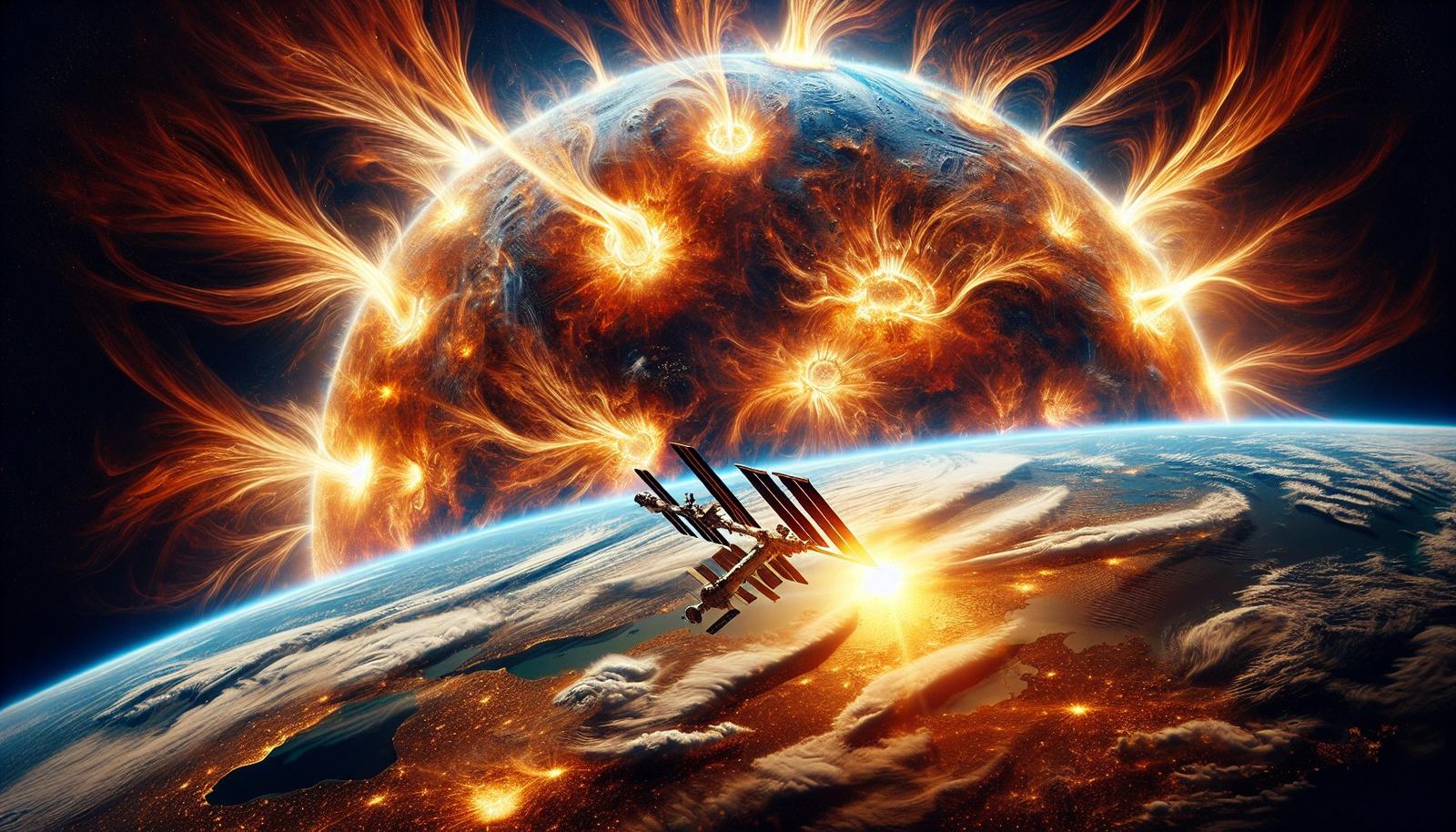
According to Professor Alexander Belyavsky, Candidate of Technical Sciences from Institute No. 6 "Aerospace" of MAI, the walls of the ISS are quite thin and will not protect the crew from radiation. If calculations show that the flare will be strong and will occur where the station is located, the crew will have to be urgently evacuated. This can be done in two days.
[...] Calculating the possible collision of cosmonauts with a mass of solar plasma is quite simple: scientists notice new dark spots on the star and establish the time of their appearance, as well as the trajectory of the emission cloud.
I note that in all 60 years of cosmonauts working on the ISS, given the regularity of solar emissions, there has never been an emergency situation - there was no need for evacuation. We can say that all these years we have simply been lucky.
The scientist notes: solar flares will not stop,"there will be exactly as many of them as there are today - no more and no less, these processes last billions of years"."Nothing critical has happened" to Earth - so far the planet is saved by a protective magnetic field.
What are solar flares and magnetic storms
Depending on the power of X-ray radiation, solar flares are divided into five classes: A, B, C, M, and X. The minimum class A0.0 is equal to the radiation power in Earth's orbit at 10 nanowatts per square meter. With each new level and new letter, the radiation power increases tenfold.
Often, flares are accompanied by emissions of solar plasma, the clouds of which, reaching Earth, can provoke magnetic storms.

By level of strength, magnetic storms are divided into:
- G1 - weak storms. On Earth, they affect the beginning of animal migrations, thanks to them auroras are visible at high latitudes (up to 60 degrees). Storms of this category cause weak fluctuations in energy systems. In space - they have a slight impact on spacecraft control systems;
- G2 - moderate storms. On Earth, they affect energy systems located at high latitudes, worsen the propagation of high-frequency radio waves at high latitudes. In this case, auroras are visible up to a latitude of 50 degrees. Spacecraft during such storms need corrective actions from control centers. They may have differences from the predicted orbital drift;
- G3 - strong storms. On Earth, they cause false alarms in protection systems in energy systems, systems need voltage correction. They also give a high "gas in oil" in oil transformers. Auroras are visible in the atmosphere up to mid-latitudes, interruptions in high-frequency radio communications and satellite navigation are possible, problems with low-frequency navigation. In space, elements of spacecraft will receive a surface charge, the spacecraft themselves may have problems with orientation, and the drift of the spacecraft from orbit may increase;
- G4 - very strong storms. Cause auroras on Earth up to the tropics, can worsen satellite navigation for several hours, trigger sporadic passage of HF radio waves, disable low-frequency navigation for several hours. Problems with voltage stability, partial destruction of energy systems and shutdown of protection systems are also possible. In space, during such a storm, spacecraft receive a surface charge and have problems tracking and orienting;
- G5 - extremely strong storms. They are capable of causing auroras on Earth up to the equator, destruction of energy systems and damage to transformers, worsening high-frequency communications, satellite navigator failures and shutdowns of low-frequency radio navigation. In space, they can affect the orientation of spacecraft in space, create problems with communication and tracking of spacecraft. All spacecraft during magnetic storms of category G5 receive an extensive surface charge.
Solar flares and magnetic storms of 2023-2024
Since the fall of 2023, the Sun has been active. In particular, in early November 2023, one ofthe most powerful magnetic storms hit the Earth, which provoked the appearance of the aurora borealis in different parts of Russia.
Intense and frequent flares continued in 2024. In early May, a series of class X flares led to a prolonged andstrongest magnetic storm on Earth since 2005. There were evenrecorded disruptions in radio communications.
However, in May, the orbit of the ISS wasnot adjusted in anticipation of the strongest geomagnetic storm, nor was the evacuation of cosmonauts carried out.
Read materials on the topic:
Russian Gonets to take control of drones over Russia
Russian SR Space to launch its own ultra-light orbital rocket with the help of investors
Never miss our newsAdd this site to your preferred sources to see us more oftenAdd on Google