Translated with AI from the Russian original.
Scientists from Perm National Research Polytechnic University (PNIPU), together with specialists from Volgograd State Agrarian University (VolGAU), have developed an innovative inspection robot capable of servicing pipelines with a minimum diameter of 500 mm. The device solves the problem of accessing worn sections of networks that are inaccessible to existing counterparts.
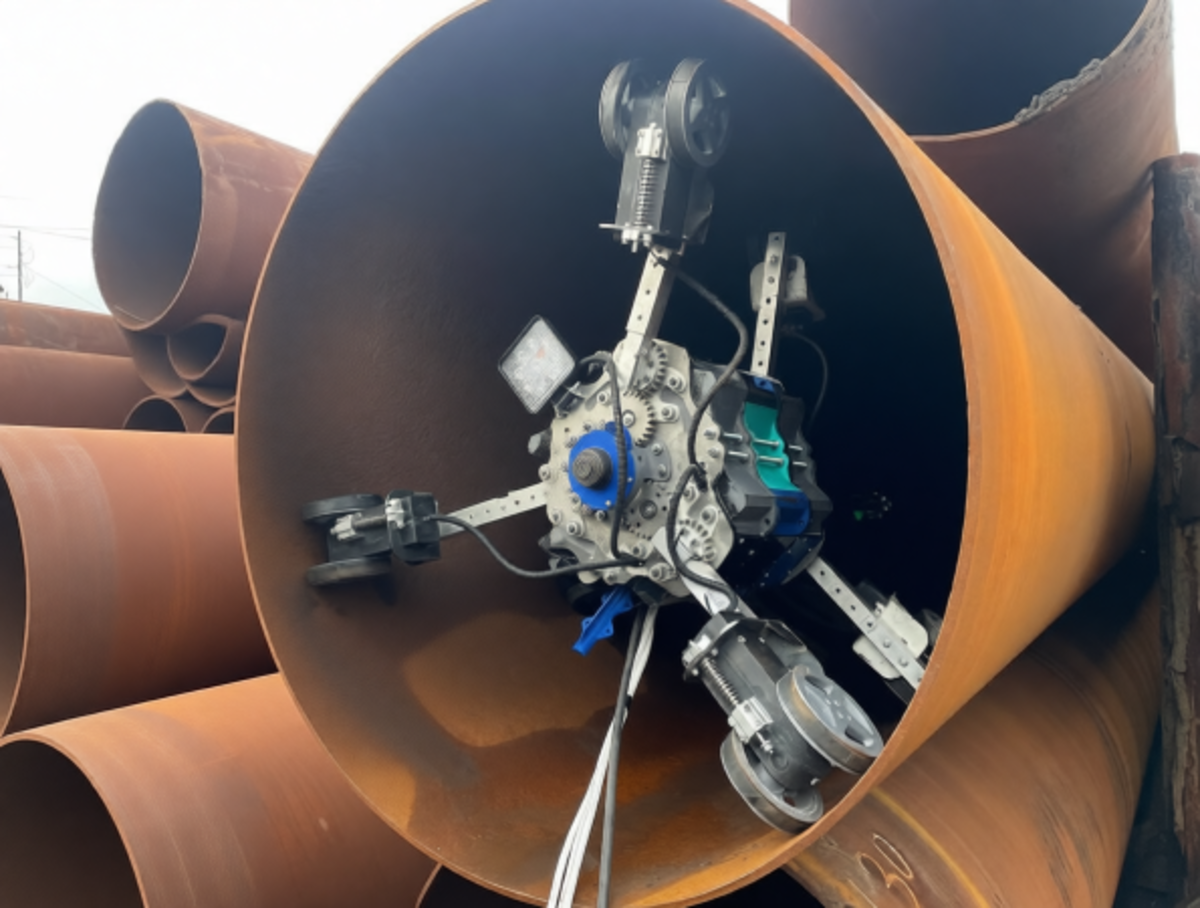
The engineering team from the two universities presented a next-generation robotic platform designed for comprehensive servicing of the interior pipe space. The uniqueness of the development lies in its ability to adapt to a diameter range from 500 to 1400 mm, which is twice as small as that of most industrial counterparts. This size opens access to old residential risers, industrial branch lines, and complex sections of pipeline networks where diagnostics and repairs were previously impossible without opening up the utilities.
A key element of the design is an original self-adaptation system based on gear engagements. While moving inside the pipe, the robot automatically adjusts its dimensions to the internal diameter, ensuring reliable fixation. Movement is provided by an intelligent chassis system: six support legs with spring suspensions keep 12 wheels in constant contact with the pipe wall. Thanks to this, the device confidently overcomes irregularities of the inner surface, passes turns of up to 90 degrees, and moves along vertical sections without losing stability.
During operation, the robot performs three key functions:
- Diagnostics — using built-in sensors and cameras, it detects defects, corrosion, and deformations;
- Cleaning — it is equipped with a special hose for hydromechanical clearing of blockages;
- Spot repair — it can deliver sealing compounds to damaged areas.
Tests confirmed the effectiveness of the solution under real operating conditions. The development is especially in demand in regions with worn-out infrastructure, where up to 60% of pipeline networks require inspection but are physically inaccessible to traditional equipment.
Read more articles:
- Strength increases by 45%: a composite reinforcement technology for aviation was developed at MAI
- Upgraded PSS-2P snow-clearing trains are heading onto the rails with digital control
- At a speed of 160 km/h: the "Ivolga 4.0" traveled the Moscow–Kaluga route for the first time
Never miss our newsAdd this site to your preferred sources to see us more oftenAdd on Google

















