Deep-sea currents remain one of the least studied areas of oceanography due to the difficulty of measurements at great depths. Russian researchers from MIPT and the Shirshov Institute of Oceanology have for the first time presented detailed data on a previously unknown current in the Vema Channel - a key pathway for the transfer of Antarctic waters to the Atlantic. The results arepublished in the Journal of Geophysical Research: Oceans.

In the autumn-winter period, extremely cold, with temperatures below two degrees Celsius, and very dense water masses are formed on the Antarctic continental shelf. These masses are called Antarctic Bottom Water. The Vema Channel is an underwater fault 700 km long, through which cold Antarctic Bottom Water (AABW) moves to tropical latitudes. Until now, it was believed that the flow here was homogeneous, but measurements in 2019-2020, carried out from the research vessel "Akademik Mstislav Keldysh", revealed a bifurcation of the current.
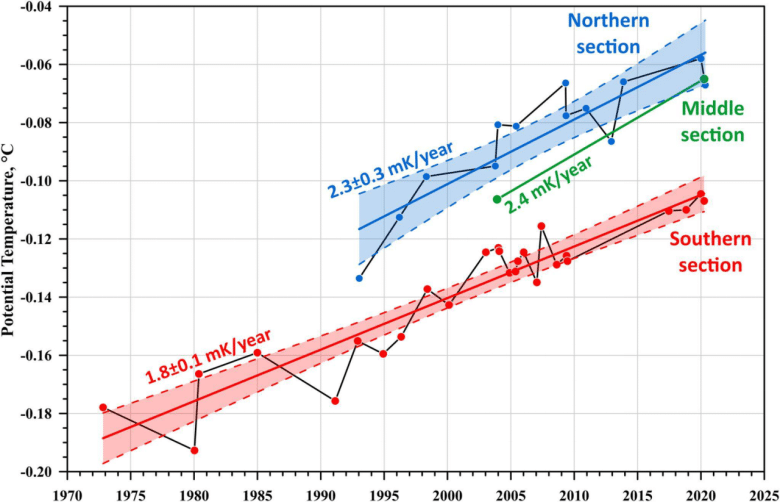
The studies were conducted in two stages: in January - on the way to the Antarctic Peninsula, and in March-April - on the way back to Kaliningrad. A total of 25 stations were made at a depth of about five kilometers. For a more detailed analysis, data from the World Ocean Database WOD-18, which were obtained earlier during a study in the Vema Channel, were also used.
The study found that the flow rate varies in different parts of the channel. In the southern part it is 31 centimeters per second, in the middle part - 17, and in the northern part - 25. At the same time, the maximum speed is observed either in the deepest layer or at a depth of about 200 meters. An additional current was also discovered in the middle part of the Vema Channel, which changes direction to the opposite. Upon re-measurement, scientists found that the speed of this current is slightly lower than in the main channel, and is 13 centimeters per second. The direction can change from north to south. Water returning from the north has a higher temperature. Vertically, the flow has a complex structure.
There is a deeper place in the canyon through which bottom water flows, and we have discovered another channel, more shallow. Warmer water spreads through it.
Scientists believe that the currents they have discovered may have a significant impact on the movement and formation of sediments in the southwestern Atlantic Ocean. In addition, shallow channels and water reuse may affect how long Antarctic Bottom Water will remain in the Vema Channel, especially in its warmer layers. This discovery is important for climate modeling, as AABW also affects global heat transfer.
Read also materials on the topic:
Compact optical filters made of quartz and silver created by Krasnoyarsk scientists
Now on home

Start of deliveries scheduled for 2027

Over 51,000 new motorcycles were sold in Russia in 2025

The car will take at least a year to assemble

The application's audience has reached 20 million users

The model will be included in the list of cars for taxis, price - from 2.25 million rubles

All parking lots of the "Administrator of the Moscow Parking Space" are connected to the service

The cars will be supplied to the Moscow Transport Service Directorate

Deliveries to India may begin in 2028

The technology provides automated search for all types of defects in power units

The plane flew 500 km, accelerating to 425 km/h

The plant stated that the information about the termination of purchases for models 6 and 8 is not true

Scientists are using the "Ekran-M" installation