Specialists from the United Engine Corporation (UEC) have revealed key aspects of the design of turbofan engines, which form the basis of modern aircraft power plants. As explained by the corporation, the most important parameter of such engines is the bypass ratio - the ratio of airflows passing through the external and internal circuits.
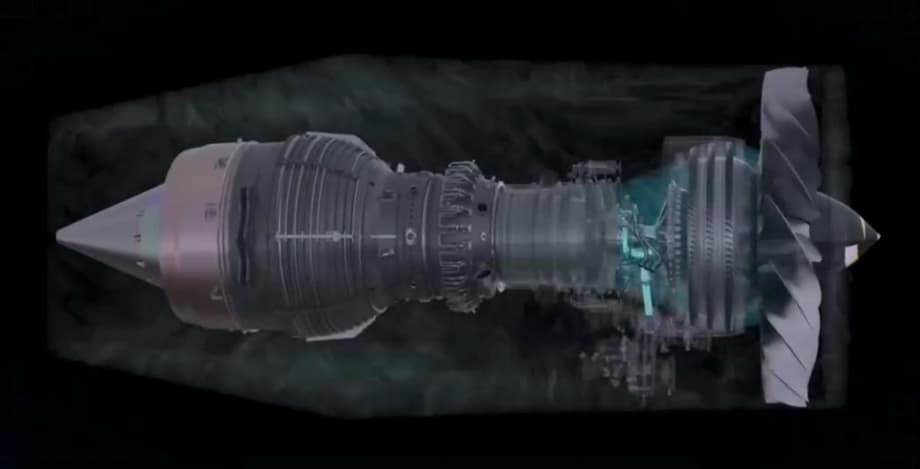
In a turbofan system, air captured by a powerful fan is divided into two directions. The main flow passes through the internal circuit, where it is compressed, mixed with fuel, ignited, and creates jet thrust through the nozzle. Simultaneously, part of the air is directed into the external circuit, enclosed in an annular cowling, increasing thrust due to energy from the same fan. For mainline aircraft, such as the MC-21 or Superjet, the external circuit thrust share reaches 80%, which significantly reduces fuel consumption and noise.
As noted by UEC, the choice of bypass ratio depends on the type of aircraft. Supersonic models use values of 0.5-2, while for passenger airliners with a cruising speed of 800-1000 km/h, optimal values range from 2 to 6. The fan and compressor stages are driven by a turbine, converting combustion energy into mechanical work.
Read more materials:
China Failed to Copy Russian Aircraft Engines: Overheating Protection Technology Remained Classified
Russia Finds a Way to Improve Ion Engines for Spacecraft
YaMZ Presents New Engines - YaMZ-770 Diesel and YaMZ-537 CNG Gas Engine
Now on home

Start of deliveries scheduled for 2027

Over 51,000 new motorcycles were sold in Russia in 2025

The car will take at least a year to assemble

The application's audience has reached 20 million users

The model will be included in the list of cars for taxis, price - from 2.25 million rubles

All parking lots of the "Administrator of the Moscow Parking Space" are connected to the service

The cars will be supplied to the Moscow Transport Service Directorate
Deliveries to India may begin in 2028
The technology provides automated search for all types of defects in power units

The plane flew 500 km, accelerating to 425 km/h

The plant stated that the information about the termination of purchases for models 6 and 8 is not true
Scientists are using the "Ekran-M" installation