The composite production facility of the Il-Vaso Company has produced a prototype of the PD-14 aircraft engine air intake made of composite material for the first time. This was reported by the company's press service.
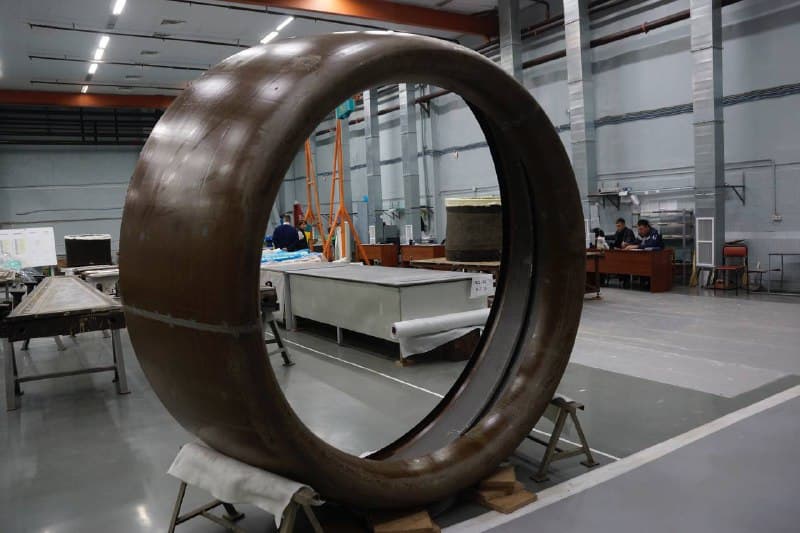
Traditionally, the design of the engine nacelle air intake includes an aluminum heated nose, but at its junction, the air flow breaks off and creates aerodynamic drag, which increases fuel consumption. The new development is designed to radically reduce this effect by changing the design and technological scheme.
Specialists have manufactured complex equipment, devised a method for uniform heating in an autoclave of a large-sized carbon fiber unit, and implemented many other ideas. The new approach will reduce the loss of effective thrust in the aircraft by up to 1%.
The developers plan to install a new air intake on the PD-14 on the Il-76 flying laboratory. This will allow testing to assess the real effect of natural laminar flow.
Only domestic materials were used in the creation of the air intake.
Earlier www1.ru reported that ODK is developing new engines for Russian aircraft, air taxis and drones.
Read related materials:
Rostec showed how 3D printing of aircraft engine parts works
Russian airports will be protected from UAVs by "Raccoons" and "Polyany"
Russian helicopter engines VK-650V have passed certification tests
Three more Tupolev workshops have been updated for the serial production of the Russian Tu-214
Now on home

Start of deliveries scheduled for 2027

Over 51,000 new motorcycles were sold in Russia in 2025

The car will take at least a year to assemble

The application's audience has reached 20 million users

The model will be included in the list of cars for taxis, price - from 2.25 million rubles

All parking lots of the "Administrator of the Moscow Parking Space" are connected to the service

The cars will be supplied to the Moscow Transport Service Directorate
Deliveries to India may begin in 2028

The technology provides automated search for all types of defects in power units
The plane flew 500 km, accelerating to 425 km/h

The plant stated that the information about the termination of purchases for models 6 and 8 is not true
Scientists are using the "Ekran-M" installation