Translated with AI from the Russian original.
A replica of the telescope, which Galileo Galilei built in the first half of 1610, has appeared at the astronomical observatory of Tomsk State University. The instrument was assembled by participants of the TSU Network Olympiad School of Physics, Mathematics, and Astronomy with the support of staff from the Faculty of Physics and the Faculty of Radiophysics.
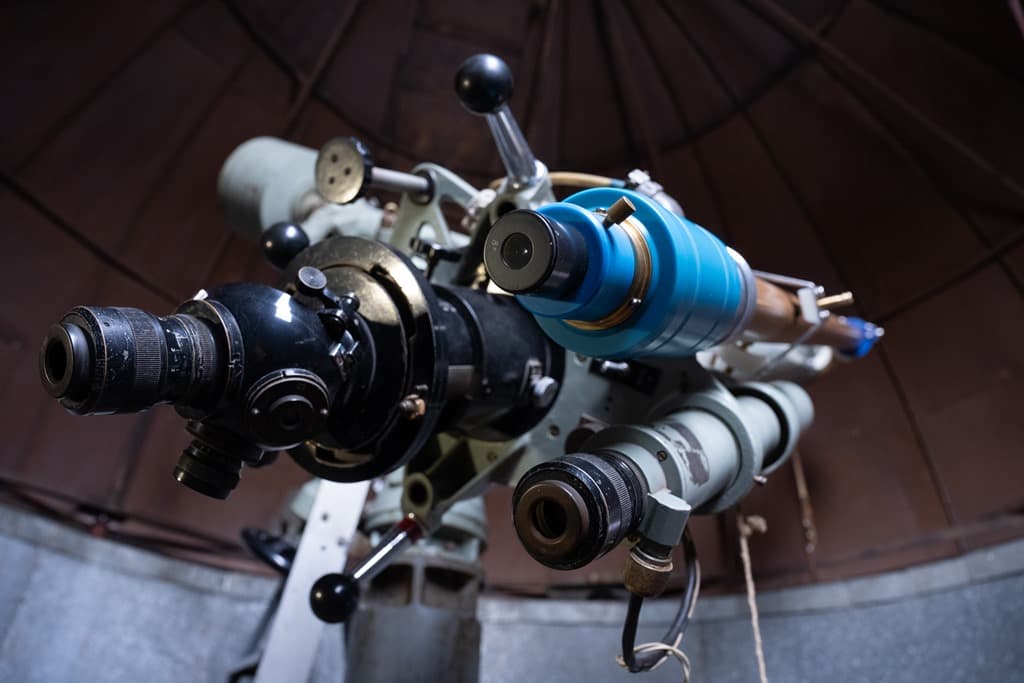
Unlike the original, where Galileo himself ground the lenses, modern creators used ready-made optical elements. The focal length of the replica is 1875 mm compared to 1710 mm for the 17th-century telescope, and the magnification is 60x versus 32x. The larger parameters allow you to see more details on celestial objects.
Mechanical parts were made by project participants. By the summer of 2024, the telescope was assembled and tested, but observing with the two-meter instrument by hand turned out to be inconvenient. Then it was decided to install the telescope in the observatory on the tube of the main AVR-3 instrument. Creating the mounts took another two years.
Now, visitors to the observatory can observe celestial bodies simultaneously with two instruments from different eras: the AVR-3 from the last century and a homemade telescope using 17th-century technologies. This allows us to understand the progress that astronomy has made in 400 years, and the difficulties faced by the first astronomers.
Read more on the topic:
Never miss our newsAdd this site to your preferred sources to see us more oftenAdd on Google

















