Translated with AI from the Russian original.
Physicists from SPbGU, together with colleagues from France and Germany, have analyzed one of the most unusual ideas in modern science: can light be made not just to transmit information, but to perform ultra-fast calculations and even simulate the behavior of space near a black hole? This refers to polaritons — hybrid particles of light and matter, in whose flows stable vortices and solitons can arise. The results of the study are published in the journal Nature Reviews Physics.
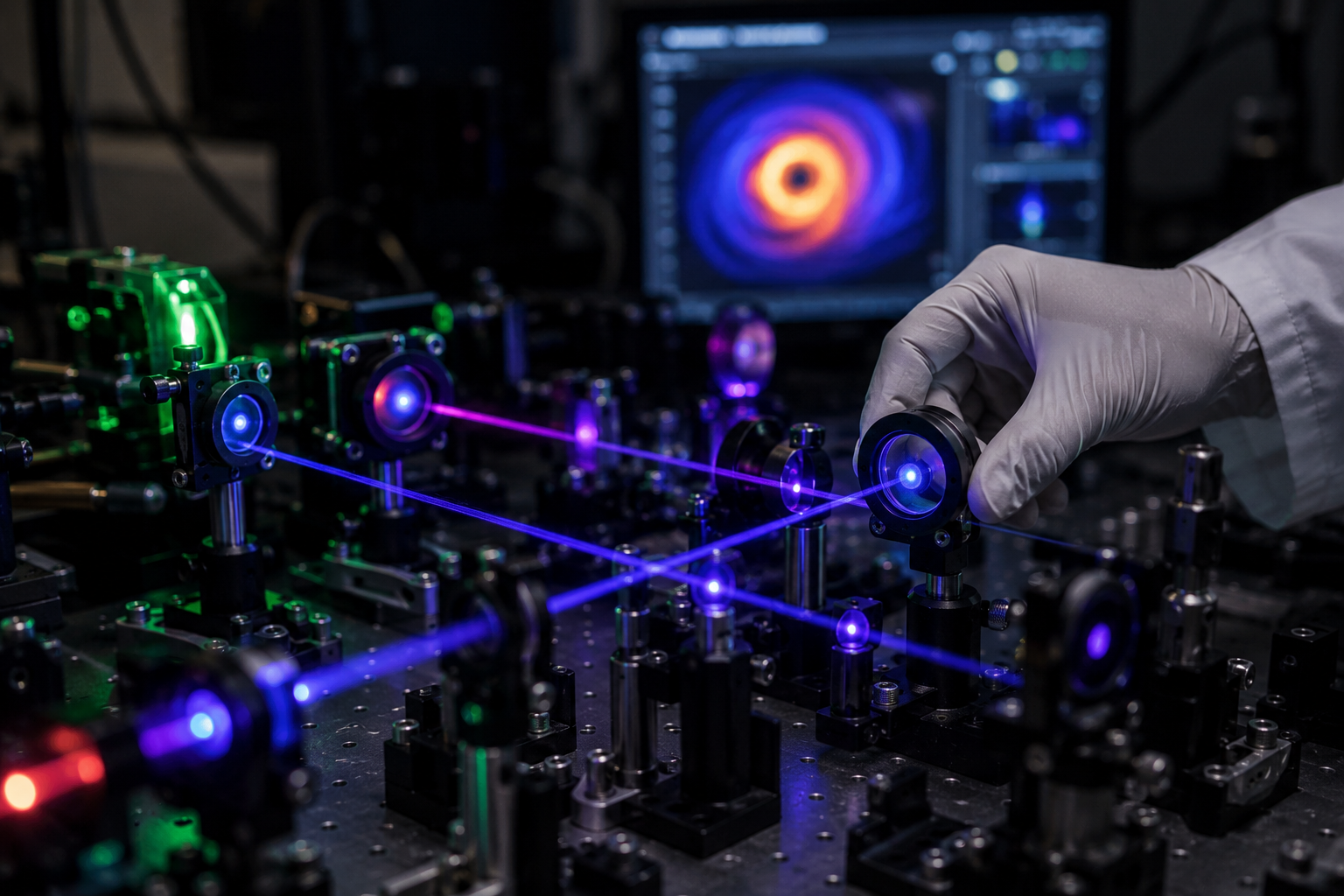
Ordinary photons — particles of light — hardly collide with each other and hardly affect each other. This is convenient for transmitting signals, but bad for calculations: it is difficult to make one light beam control another. Therefore, physicists have long been looking for a way to make light behave more like matter and be more susceptible to external influences.
Polaritons help solve this problem. They arise inside a semiconductor microcavity, where a photon is repeatedly absorbed and re-emitted by an exciton. As a result, a hybrid quasiparticle appears: it gets lightness and speed from the photon, and the ability to interact with other particles from the exciton. It is this interaction that allows the creation of stable structures — light vortices and solitons.
Polaritons have been studied for more than 30 years. Previously, their production required ultra-low temperatures, almost close to absolute zero, but new materials like perovskites, zinc oxide, and organic crystals allow such states to be created at room temperature.
Scientists from Russia, France, and Germany have gathered everything currently known about polariton vortices and solitons. They showed that such structures can be used for computing devices: elements based on them already operate at a frequency of 100 GHz, and a vortex rotating in different directions can act as a qubit. Experiments by SPbGU and Westlake University in 2024 showed an operation accuracy of 95–98%, and flows of "liquid light" can also simulate the behavior of spacetime near the event horizon of a black hole.
Read more on the topic:
Never miss our newsAdd this site to your preferred sources to see us more oftenAdd on Google

















