A new construction material has been developed in Russia that is significantly stronger than foreign counterparts. Scientists at Perm National Research Polytechnic University (PNRPU) have created polymer concrete that surpasses foreign solutions by an average of 15–20%, while being entirely composed of readily available raw materials.
What is this material?
Today, polymer concretes based on epoxy resin are used in construction — they are stronger than ordinary concrete and better withstand external influences. However, there have been no systematic developments of this kind in Russia.
PNRPU scientists have created the first domestic polymer concrete, which not only fills this niche but also surpasses foreign counterparts in strength. This opens up opportunities for import substitution in construction and industry.
Where can it be used?
The new material is suitable for tasks where strength and resistance to loads are particularly important:
- foundation construction;
- road surfaces;
- bridges;
- railway tracks;
- installation of heavy equipment.
It is designed for constant dynamic loads and vibrations.
How was the polymer concrete made?
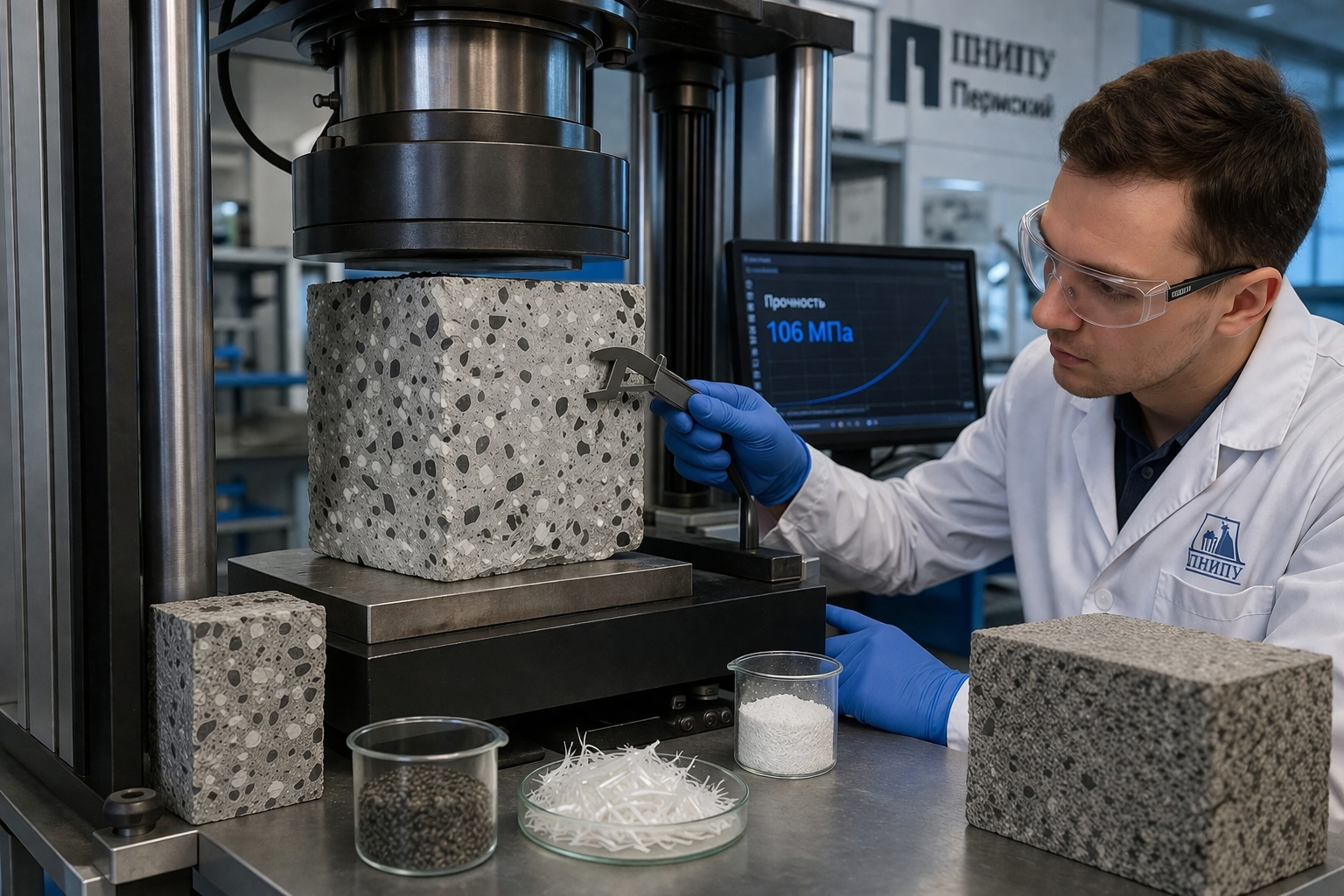
The material is based on epoxy resin. To turn it into a durable structural composition, scientists added white soot and aerosil, iron oxide, chopped fiberglass, a moisture-protecting component, and quartz sand. The mixture was poured into metal molds and kept at room temperature for seven days — during this time, the material completely hardened, and the fillers were fixed in its structure.
We manufactured several variants of the mixture with different filler contents, varying the concentration. For each variant, we recorded the appearance of the material, its consistency, ease of laying, and then, after hardening, assessed its strength and other properties. As a result, we empirically determined that the optimal ratio is 40% resin and 60% fillers.
How strong is it?
The material was tested for compression using a hydraulic press — to understand how it behaves under real loads.
Results:
- up to 106 MPa — for the new polymer concrete;
- 20–40 MPa — for ordinary concrete;
- 80–90 MPa — for foreign counterparts.
In addition, the material is resistant to moisture, temperature changes, and chemical influences.
Read more on the topic:
Never miss our newsAdd this site to your preferred sources to see us more oftenAdd on Google

















