Translated with AI from the Russian original.
In Russia, an axial electric motor has been developed that requires fewer expensive rare-earth magnets while maintaining almost the same power and torque characteristics. The project was authored by engineers from Immanuel Kant Baltic Federal University in Kaliningrad.
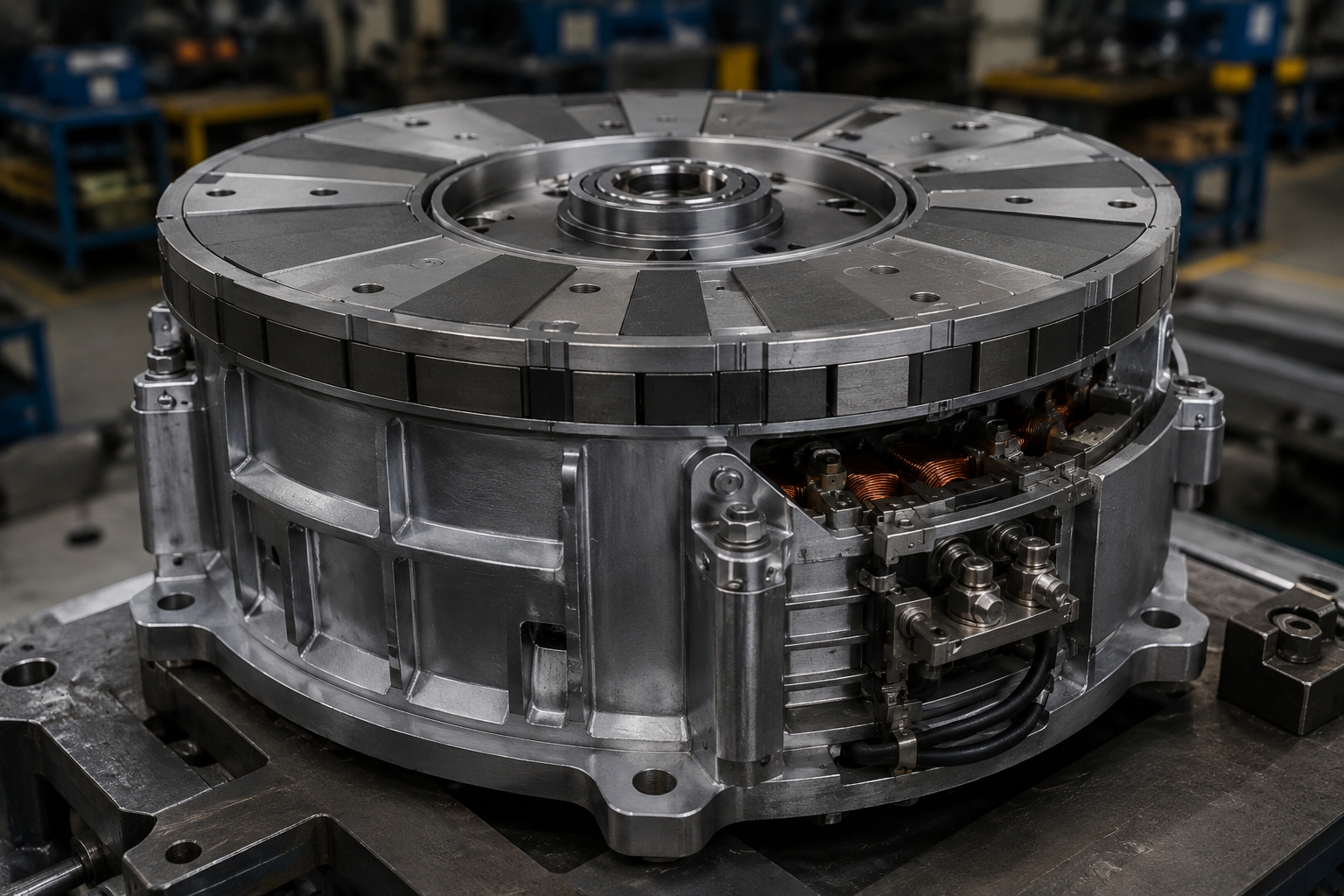
The new design belongs to permanent magnet synchronous motors. The main feature is a modified Halbach magnetic array, in which part of the neodymium magnets were replaced with ferromagnetic inserts. This allowed reducing the volume of magnetic material by approximately one third.
The developers used a scheme with two disk rotors and an ironless stator. Between the rotors are magnetic sections consisting of nine elements: one axially magnetized magnet, four tangential magnets, and four ferromagnetic inserts. This arrangement concentrates the magnetic field in the working gap of the motor and reduces losses.
According to simulations, the peak magnetic induction of the new system was close to classic Halbach arrays, although the proportion of magnetic material in the design was reduced to 66.7%. At the same time, the magnetic field decay with distance remained practically unchanged.
Engineers also redesigned the mounting of the magnetic sections. To protect against centrifugal and axial loads, the design includes external retaining walls and non-magnetic casings. This should increase the reliability of the motor at high speeds.
The authors of the development believe that the use of a combined magnetic system will reduce the cost and weight of axial electric motors without a significant decrease in efficiency.
Read more on the topic:
Never miss our newsAdd this site to your preferred sources to see us more oftenAdd on Google

















