Scientists have created a method for safely extracting "fire ice" in the Arctic — a computer model that assesses in advance whether the cement slurry will destroy gas hydrates in the well. The development was presented by researchers from Perm Polytechnic University together with colleagues from China and Saudi Arabia.
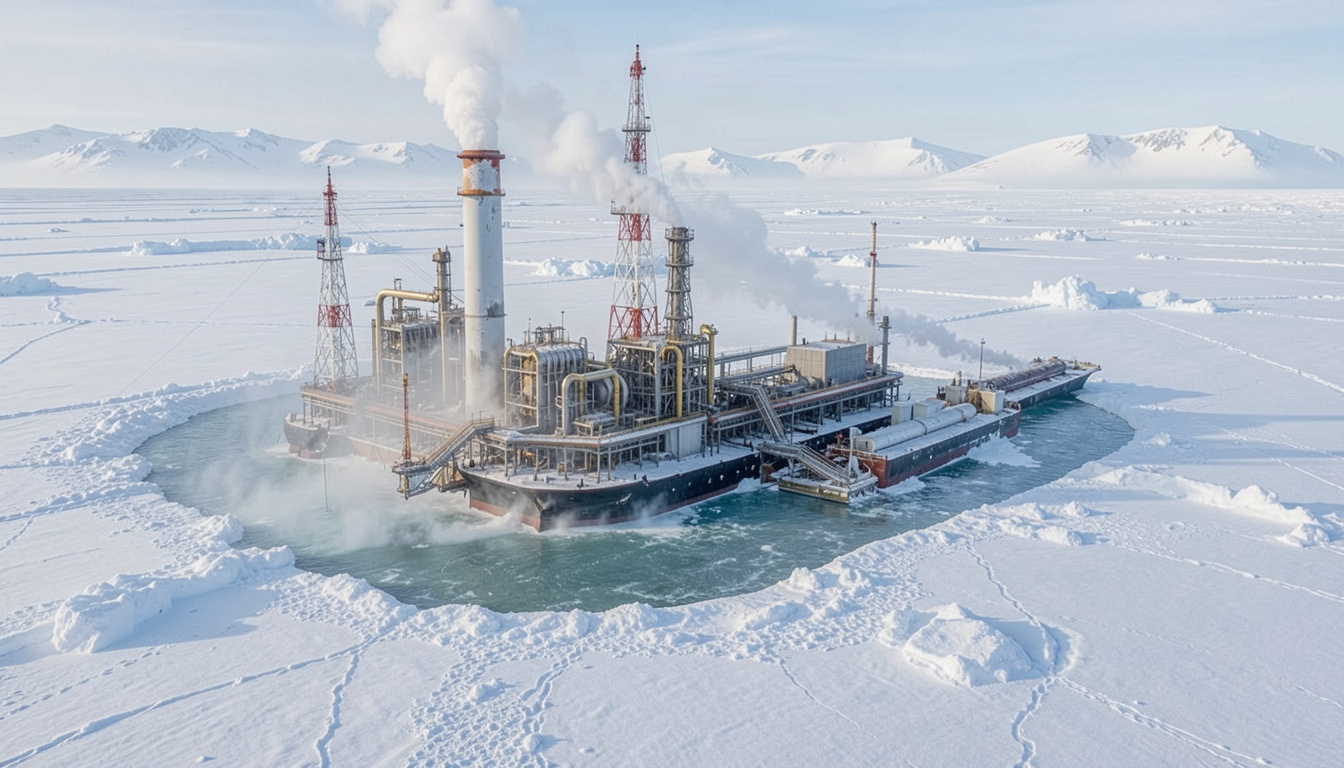
"Fire ice" is gas hydrates in which methane is trapped in a crystalline lattice of water. One cubic meter of such a compound yields up to 180 cubic meters of gas. The main reserves are concentrated in the Arctic and permafrost zones: Russia owns some of the largest deposits — from the Barents to the Chukchi Sea, as well as deposits in Yakutia and Western Siberia.
Traditionally, wells are strengthened with cement slurry with polymers for viscosity, but water with additives seeps into the rock and destroys hydrates before the cement hardens. To exclude this scenario, the team built a virtual model of the process: they simulated the contact of cement slurry with hydrate at different concentrations of polymers (from 0.5 to 1.5%) and temperatures corresponding to the conditions at the bottom of the ocean.
The researchers tested 22 molecular systems at pressures from 5 to 10.5 MPa. It turned out that amide groups are the most aggressive: at a concentration of 1.5%, they reduce the stability temperature of the hydrate by almost 3 °C. Even more dangerous is the combination of nitrogenous and acidic groups — the shift reaches 3.56 °C. Sulfur-containing additives turned out to be the least harmful.
The model works like an engineering calculator: the specialist uploads the composition of the cement slurry, and the program shows whether the destruction of hydrates will begin. If there is a risk, the system suggests replacing the components with safe ones.
Read more on the topic:
- Perm scientists managed to reduce harmful emissions from gas turbines by 30%
- A method for more accurately calculating the properties of soils for roads was developed at PSU: the optimal proportion of argillite is 40-50%
- Graphite and Plasma: New Material for Aviation and Nuclear Reactors Invented at PNRPU
Never miss our newsAdd this site to your preferred sources to see us more oftenAdd on Google

















