Fake scientific texts and unreliable bibliographic data generated by neural networks are becoming an increasingly noticeable problem. Experts from Herzen State Pedagogical University of Russia have proposed creating a unified database of such publications to prevent their dissemination and use in new research.
The initiative was announced at the scientific and practical conference "Science Analytics: Statistics, Analytics and Evaluation of Scientific Research." Scientists spoke about the results of the fundamental library's work to identify unreliable information that is already being published in reputable scientific journals, collections of articles, and conference proceedings.
Back in March 2026, specialists from Herzen State Pedagogical University of Russia presented a service to combat "new plagiarism." As the researchers noted, such situations arise due to the incompetent interaction of researchers with generative AI models. Now, experts have proposed specific measures to stop the mass penetration of such data into scientific publications.
A further step in solving the problem could be the development of services that allow high-quality and reliable identification of confabulations using software algorithms. It is possible to create a unified database of publications that have been retracted due to unreliable generated bibliographic information (and with it, fake research texts) as well as hallucinations in them. This will help to avoid chains of further dissemination of already published "phantoms" in subsequent articles, which is already actively happening in the foreign scientific space.
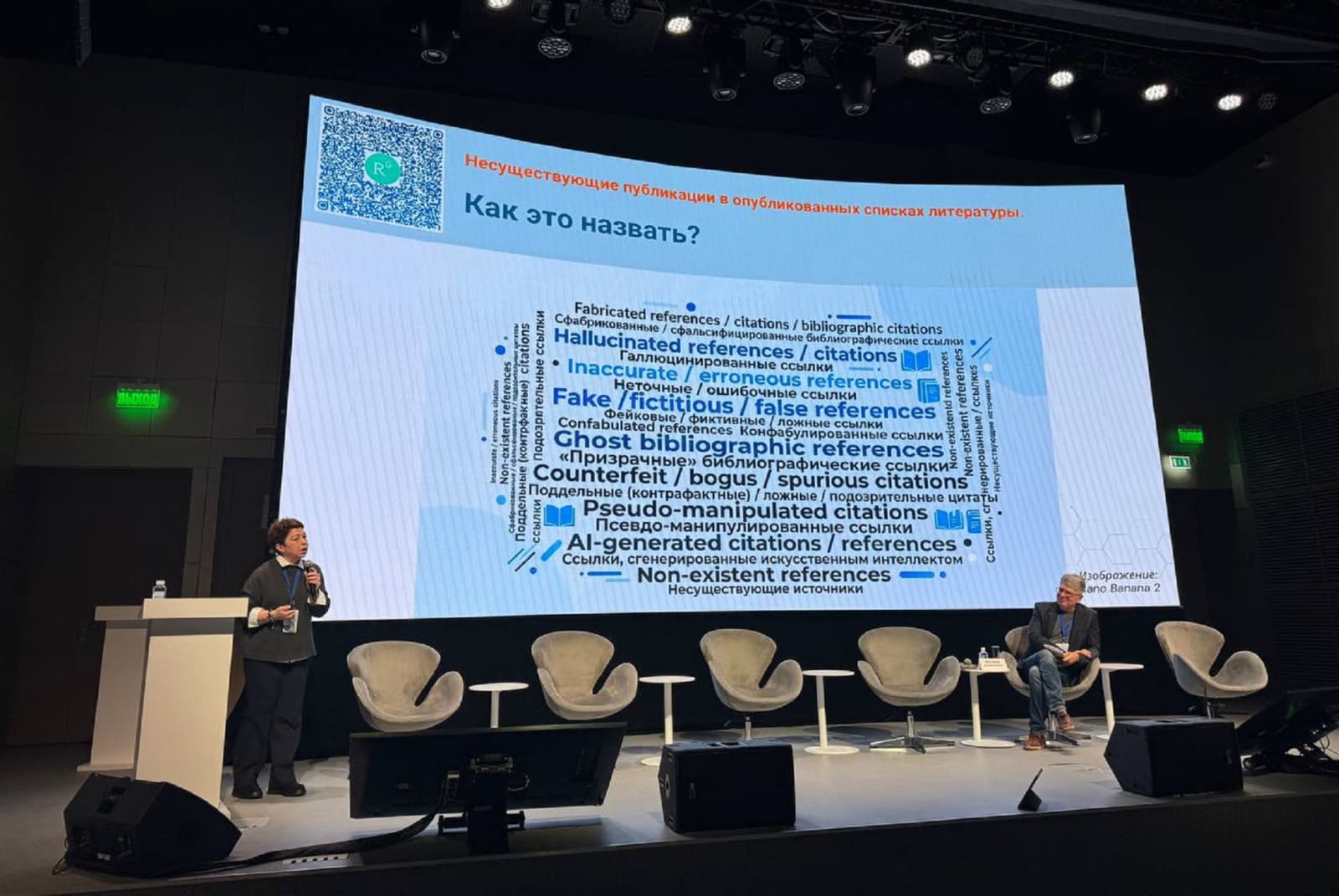
The conference, organized by the scientific electronic library eLibrary, took place in the technological valley of the INTC MSU "Vorobyovy Gory." It was attended by representatives of the Russian Academy of Sciences, the Russian Center for Scientific Information, Moscow State University, St. Petersburg State University, the Higher School of Economics, RANEPA, the Federal Institute of Industrial Property, and other scientific and educational organizations.
Among the topics discussed were indicators of scientific and technological development, open data and transparency of scientific communication, digitalization of science, and the active introduction of artificial intelligence.
Read more on the topic:
Never miss our newsAdd this site to your preferred sources to see us more oftenAdd on Google

















