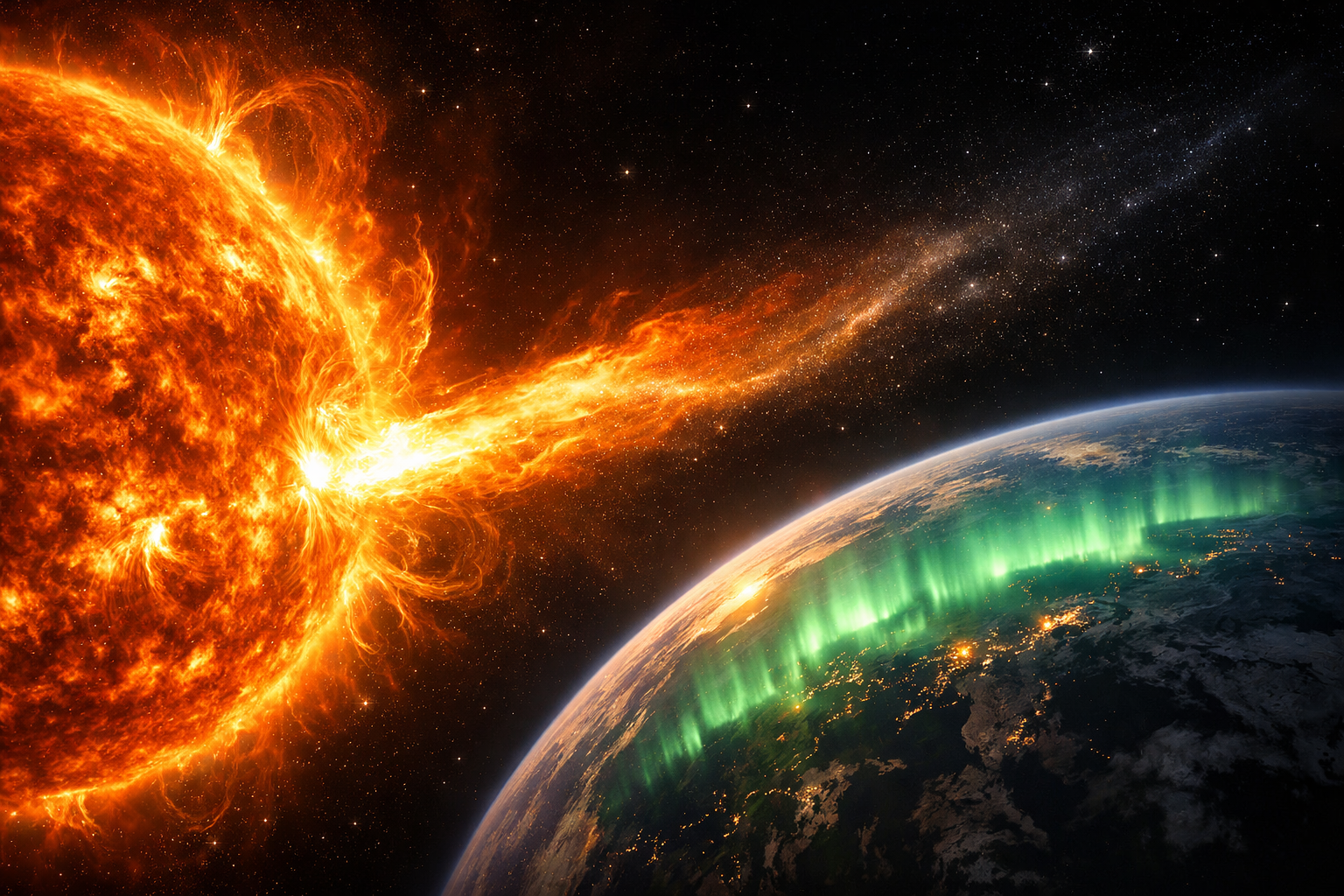
An M2.7 class flare in the X-ray range was recorded on the Sun on March 18 at 11:44 Moscow time. This was reported to TASS at the Institute of Applied Geophysics (IPG). The new flare occurred against the background of the already confirmed arrival to Earth of a plasma ejection from the M-class flare that occurred on March 16. According to the Solar Astronomy Laboratory of the Institute of Space Research of the Russian Academy of Sciences and the Institute of Solar-Terrestrial Physics, the ejection will reach Earth on Thursday, March 19 — geomagnetic storms of level G2-G3 are expected, which may be the strongest in two months. Auroras are possible.
Why the upcoming magnetic storm is stronger than usual
The flare on March 16 occurred almost exactly opposite the Earth — in this configuration, the impact of the plasma cloud on the planet's magnetosphere is always noticeably enhanced, the scientists noted. Several new coronal holes have appeared on the side of the Sun facing the Earth in recent days — this factor will begin to affect the geomagnetic situation closer to the weekend.
What do storm levels G2 and G3 mean
Solar flares are divided into five classes according to the power of X-ray radiation: A, B, C, M, and X. When moving to the next letter, the power increases tenfold. Geomagnetic storms of level G2 cause disruptions in the operation of satellite orientation systems and high-frequency radio communications at high latitudes. G3 storms are capable of affecting power systems and spacecraft, creating interruptions in satellite navigation and interruptions in low-frequency radio navigation.
Space weather forecast for March 18–19, 2026
- Recorded flare: M2.7, March 18, 11:44 Moscow time — IPG
- Expected event: arrival of plasma ejection from the M-class flare on March 16
- Arrival date: March 19 (Thursday)
- Predicted storm level: G2-G3
- Additional factor: several new coronal holes on the side of the Sun facing the Earth
- Possible phenomena: auroras, radio communication disruptions, impact on power systems and satellites
Auroras during a G2-G3 storm are observed at the latitudes of St. Petersburg, Murmansk, and northern Siberia. For operators of satellite groups and power systems at high latitudes, the next 24 hours will require increased attention: a G3 level storm creates real risks for ground infrastructure and orbital vehicles.
Read more materials on the topic:
- Solar flare of level M2.8 caused a plasma ejection towards Earth: the strongest magnetic storm in two months is expected
- A magnetic storm has begun on Earth: level G1
- A huge coronal hole has appeared on the Sun: it may affect the Earth as early as March 13
Never miss our newsAdd this site to your preferred sources to see us more oftenAdd on Google














![Growth Point: After 5G Launch, Mobile Internet in Russia Accelerated by 20%","subtitle":"TelecomDaily recorded an upload speed increase of 19.7%, and download speed of almost 14%","announce":""}[]}],](https://media.ixbt.site/fit-in/320x/ixbt-data/1727896/ai-image-nvgq0a0v5cjnyxwoc8xpelva.webp)