Researchers from the Ioffe Physical-Technical Institute (FTI) for the first time experimentally proved that coupled pairs of spin waves – magnons – can be controlled with light. As reported by the Russian Science Foundation, which supported the work, this opens a direct path to creating processors and memory in which information is transmitted without Joule heating.
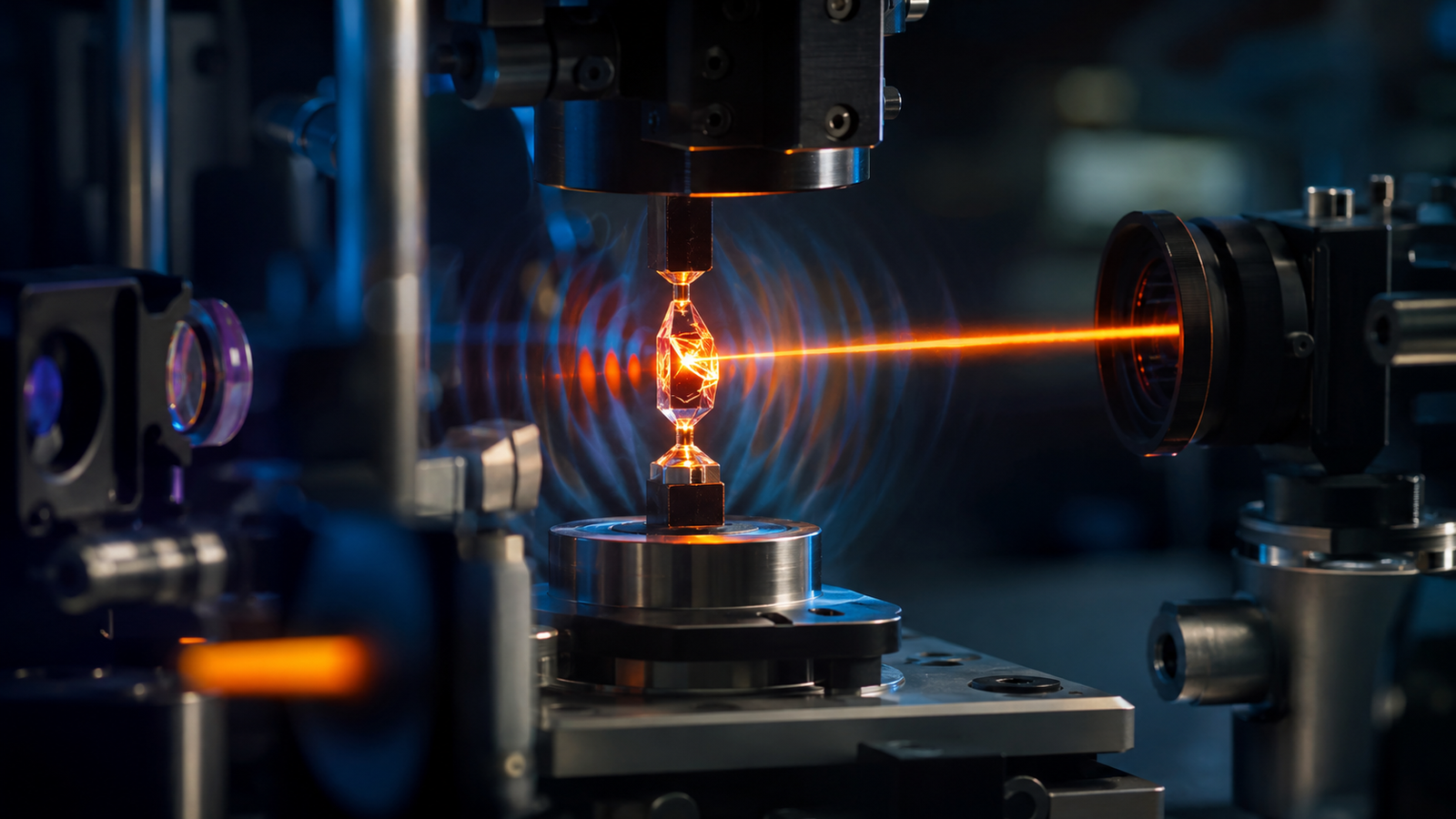
Physicists irradiated a rubidium manganese trifluoride crystal with a powerful femtosecond laser, exciting magnon pairs, and read their dynamics with a second, probing pulse. It was found that an ultrashort flash instantly rearranges the exchange interaction between the magnetic moments of neighboring atoms, causing the spins to oscillate in unison.
Unlike electrons in silicon chips, which dissipate up to a third of their energy as heat, these waves oscillate at terahertz frequencies with virtually no losses.
By changing the laser polarization and the orientation of the sample, the length of the excited magnons can be selectively set. This transforms the technology from a laboratory exotic into an engineering tool for post-silicon electronics, where information is carried not by charges, but by spin excitations.
Read more on the topic:
Never miss our newsAdd this site to your preferred sources to see us more oftenAdd on Google

















