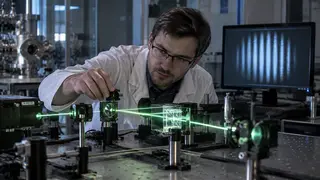
The Ioffe Institute (PTI) is developing quantum cascade lasers that will provide atmospheric optical communication in Arctic conditions — in fog, snowfall and strong winds. This was reported to RIA "Novosti" by the chief researcher of the institute, Professor of the Russian Academy of Sciences Grigory Sokolovsky.

Today, only radiotelephone and satellite communications are available in the Arctic. Laying optical fiber in the region is difficult and economically impractical. An alternative is atmospheric optical communication via an open beam, without cables: the receiver and transmitter are in direct line of sight and exchange data between ships, the shore or elevations. Existing systems at a wavelength of about 1.5 μm operate stably in clear weather, but in fog, communication degrades and disappears.
The solution is to switch to wavelengths of 4–5 or 8–12 μm, at which radiation passes much better through fog and precipitation. This requires quantum cascade lasers: unlike conventional diode lasers, they have no holes — only electrons, which, under the influence of voltage, move along quantum levels in nanoscale layers of the heterostructure. The technology is complex and still requires refinement for industrial production.
The first practical results have already been obtained: in the autumn of 2025, in Sarov, specialists from the RFNC — VNIIEF transmitted and received data at a speed of 0.1 Gbit/s in real conditions using a quantum cascade laser at a wavelength of about 8 μm, operating at room temperature. The laser was developed at the Ioffe Institute.
In addition to communication, such lasers are applicable for remote detection of leaks in pipelines, monitoring fields, controlling fuel quality and analyzing exhaled air in medical diagnostics. According to Sokolovsky, before a full-fledged weather-resistant communication system, it is necessary to solve the problems of increasing power, modulation speed, creating sensitive receivers and beam guidance systems — several leading Russian research institutes are joining the project.
Read more materials on the topic:
- Russian space laser communication terminal developed at MIPT
- Roscosmos will launch experimental satellites with laser communication
- For lidars, optical communication, laser rangefinders: Rostec will increase the production of avalanche photodiodes
Never miss our newsAdd this site to your preferred sources to see us more oftenAdd on Google