Translated with AI from the Russian original.
During the night, the second geomagnetic storm of February began on Earth, peaking at 05:00 Moscow time and reaching level G1.3 on the five-point scale, corresponding to a weak or close-to-moderate storm. The disturbance manifested about a day earlier than forecasts due to a large coronal hole on the Sun facing the planet.

Earlier, a weak storm was recorded on February 5, with the pause between the events amounting to about ten days. Overall, February has so far been calmer than January, which was marked by a record number of storms for the decade, with the main activity in the second half of the month.
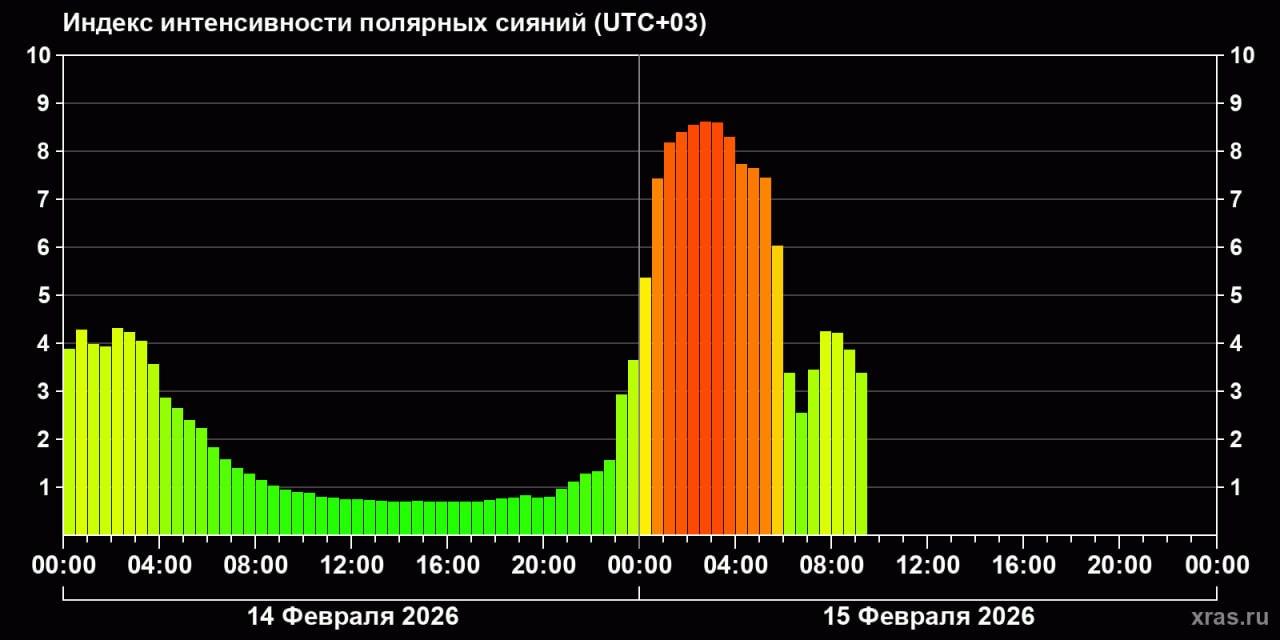
The current period of geomagnetic instability may continue for up to two days with uneven surges, while the probability of intensification to level G2 is assessed as low. Against the backdrop of the disturbances, the aurora intensified noticeably: the brightness index reached 8.6 out of 10. The best conditions for observations were in the northwestern regions of Russia from 01:0 to 5:00
The possibility of seeing the aurora will remain until mid-May, after which the reduction of nighttime hours and the high position of the Sun above the horizon will make observations practically impossible even for record-strength storms.
According to data from the Laboratory of Solar Astronomy of the Space Research Institute and the Institute of Solar-Terrestrial Physics, no reliable observations of the aurora have yet been registered in the central regions.
Read more materials on the topic:
- The Sun \"smiled\" and unleashed a powerful flare on February 13
- Another powerful flare on the Sun: the explosion occurred on February 12
- Space is restless again: three powerful flares occurred on the Sun on February 11
Never miss our newsAdd this site to your preferred sources to see us more oftenAdd on Google

















