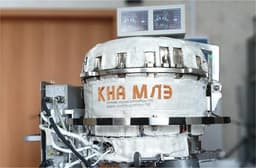
Scientists at the Kabardino-Balkarian State University have begun developing a new type of detector for studying neutrinos - almost elusive particles that play a key role in cosmic physics. The technology will be tested at the Baksan Neutrino Observatory.

The development is based on nanocrystals of the rare mineral perovskite, supplemented with a special isotope sensitive to the rarest process - neutrinoless double beta decay. This may help to find out whether neutrinos are both particles and their antipodes at the same time - one of the main mysteries of modern physics.
The created nanocrystals can glow when absorbing energy, which will allow registering traces of particles.
It is planned to start with a prototype with a volume of 1 liter, and in the future, installations of up to 10 tons are possible.
Read more materials on the topic:
Distant guest: a gamma quantum of record power was registered by Russian scientists
Construction of the Baikal-GVD neutrino telescope continues on Lake Baikal