Specialists from UrFU and the Institute of Electrophysics of the Ural Branch of the Russian Academy of Sciences have developed an innovative SiAlCN (silicon-aluminum-carbon-nitrogen) coating that protects aircraft engine components from oxidation at extreme temperatures up to 1400°C. The technology combines low synthesis temperatures (up to 400°C), high deposition rate and hardness up to 31 GPa, comparable to diamond-like materials.
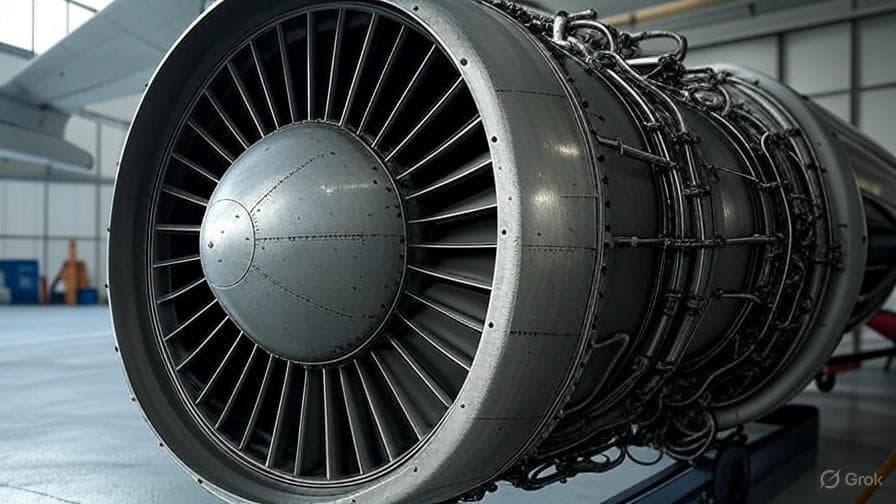
The coating was created using a hybrid synthesis method that combines aluminum evaporation and plasma activation of a silicon-organic precursor. Over two years of testing, scientists have formed a dense nanocomposite structure without defects, which is critical for resistance to thermal oxidation. For comparison: traditional methods require heating above 1000°C and often lead to microcracks.
We can apply the coating not only to steel and titanium, but also to fusible materials, such as polycarbonate. The process is scalable for industry - it all depends on the specific tasks
The new material is planned to be tested on gas turbine and jet engine components. In parallel, a second type of coating with anomalously high piezoresistivity has been developed, which will allow the creation of thin-film sensors with a thickness of tens of microns. Such sensors are 10 times more sensitive than existing analogues.
The SiAlCN coating will increase the service life of aircraft engines. Low-temperature synthesis expands the scope of the technology - from the aerospace industry to microelectronics.
Read also on the topic:
The most powerful Russian aircraft engine PD-35 will be redesigned for the energy sector
Now on home

Start of deliveries scheduled for 2027

Over 51,000 new motorcycles were sold in Russia in 2025

The car will take at least a year to assemble

The application's audience has reached 20 million users

The model will be included in the list of cars for taxis, price - from 2.25 million rubles

All parking lots of the "Administrator of the Moscow Parking Space" are connected to the service

The cars will be supplied to the Moscow Transport Service Directorate

Deliveries to India may begin in 2028

The technology provides automated search for all types of defects in power units

The plane flew 500 km, accelerating to 425 km/h

The plant stated that the information about the termination of purchases for models 6 and 8 is not true

Scientists are using the "Ekran-M" installation