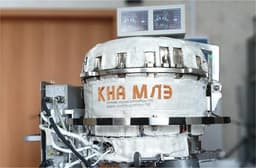
Scientists have studied the effect of ultraviolet radiation on dust movement on the Moon. The results of the study showed that ultraviolet light reduces the activation threshold of particles, which contributes to their activation and movement.
The study was conducted with the participation of the V.I. Vernadsky Institute of Geochemistry and Analytical Chemistry of the Russian Academy of Sciences, the Space Research Institute of the Russian Academy of Sciences, Moscow State University, Moscow Power Engineering Institute, and MIPT.
Experiments have shown that ultraviolet radiation reduces the activation threshold of particles by 1.5–3 times, depending on the material.
Lunar dust poses a threat to equipment due to its abrasiveness. The study will help to better understand the dynamics of dust on the Moon and other airless bodies, as well as reduce risks to spacecraft.
In an experimental setup, scientists investigated the effect of ultraviolet radiation and electrostatic fields on particles simulating lunar regolith. During the experiments, it was found that ultraviolet radiation increases the charge of particles, which also contributes to their activation. The use of a stereo pair of high-speed video cameras made it possible to accurately analyze the trajectories and velocities of particles.
The results confirm theoretical models and help predict the behavior of dust on the Moon, and may also be useful for developing systems to protect spacecraft in future missions.
Read materials on the topic:
Scientists from LETI have developed a space debris monitoring system
The Plasma Crystal experiment is being conducted on the Russian segment of the ISS
The secret of the second planet: Roscosmos declassified documents of the Venera-Gallei project