Translated with AI from the Russian original.
The Roscosmos State Corporation has declassified details of the development of Soviet scientists' ideas for studying Venus and Halley's Comet. The second planet from the Sun in the terrestrial group began to be actively explored in 1985 with the help of the Vega-1 and Vega-2 spacecraft, communication with which ceased by March 1987. To mark the fortieth anniversary of the launch of the large international project in the field of unmanned cosmonautics "Venus-Halley", the details of its preparation were revealed.
Project "Venus-Halley"
According to the documents, the first spacecraft for studying Venus were developed by the Lavochkin Research and Production Association and related organizations in 1980. They were to conduct space research using a floating balloon station and an artificial Venus satellite. France also actively participated in the project - its National Space Center developed a balloon system and part of the scientific equipment of the floating balloon station and an artificial Venus satellite.
However, "the French side disrupted the previously agreed deadlines for the development of a joint Soviet-French preliminary design by six months, which cast doubt on the timing of the project," and then the Lavochkin Research and Production Association developed a new version of the spacecraft, more economical, but less dependent on foreign cooperation. It was decided to send two identical spacecraft to Venus in late 1984, named Vega-1 and Vega-2. A number of systems, in comparison with the original project, had to be refined, since their continuous operating life was approximately 360 days, which was not enough to complete the mission.
"Vega-1" and "Vega-2"
Spacecraft developed for the implementation of the "Venus-Halley" project. Their technical characteristics and equipment were absolutely identical, so that in the event of a crash or emergency with one of the spacecraft, the second would complete the scientific mission. Each such automatic interplanetary station weighed about 4.9 tons.
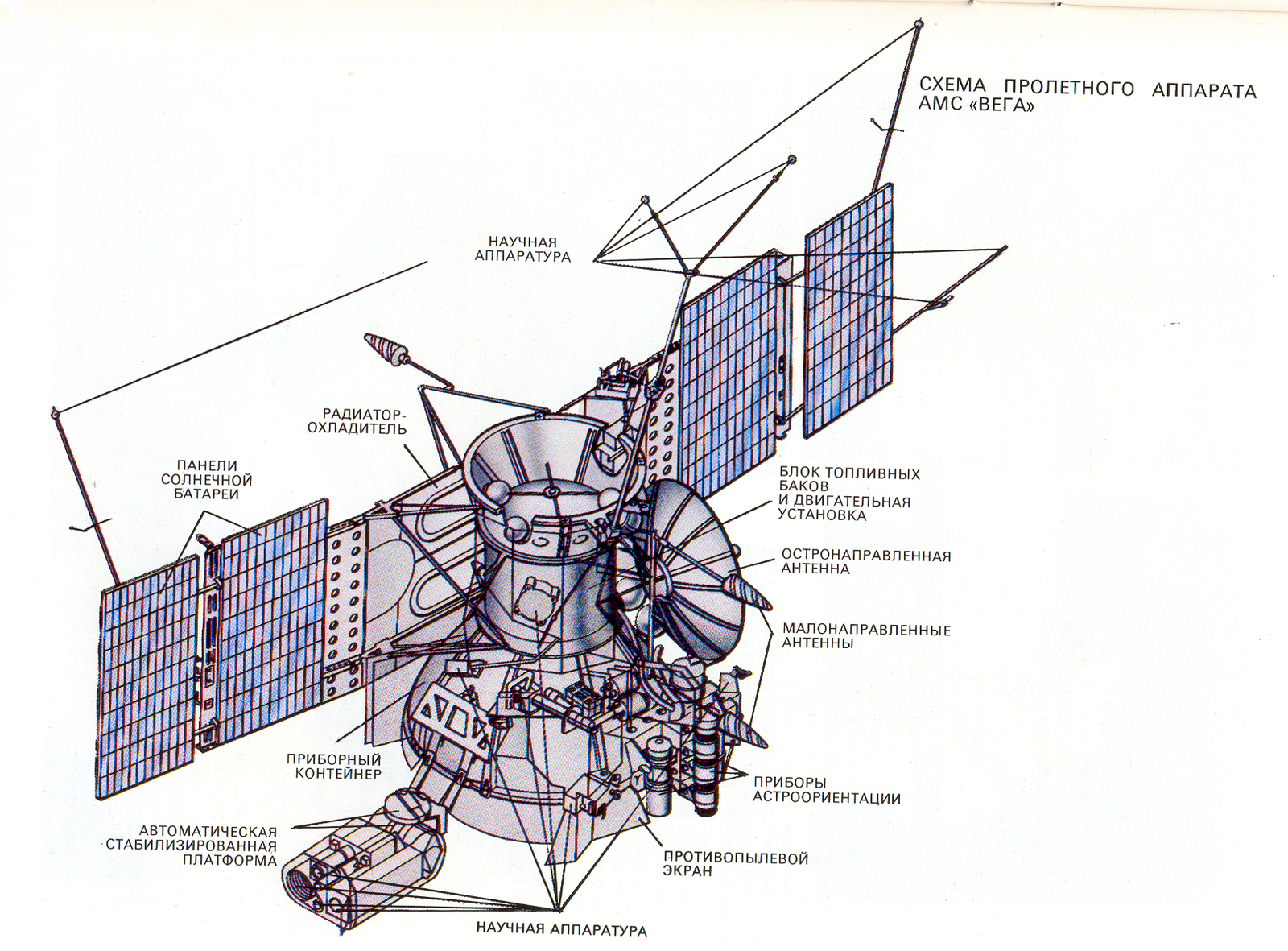
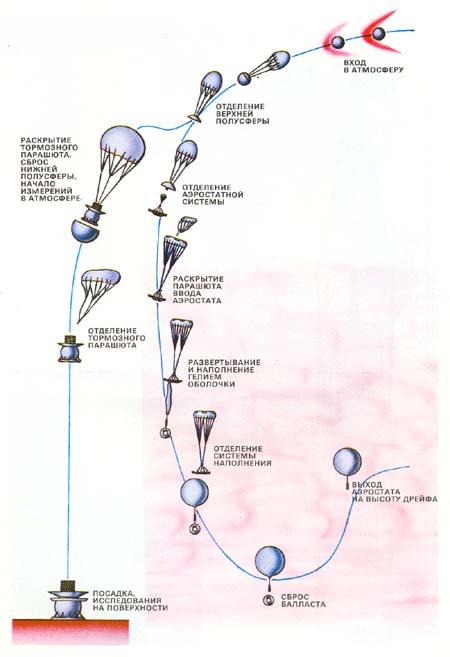
Each of the spacecraft was accompanied by a descent station, conducting scientific research both in the atmosphere of Venus, in the descent section, and on the surface of the planet. Also, the Vegas received a small balloon probe to the stations, drifting in the atmosphere of Venus in order to determine its circulation. The balloon probe in space for research was used for the first time in world practice.
According to the Lavochkin Research and Production Association project, information from the descent vehicles was to be relayed to the Vegas, and then to Earth. Information from the balloon probe about the Venusian atmosphere was to be transmitted directly to Earth.
The project became international: more than twenty units of unique scientific equipment were developed by the USSR together with Bulgaria, Hungary, the Polish People's Republic, Czechoslovakia, with the participation of France, Germany, the USA and Austria. To coordinate the work of scientific and industrial cooperation involved in the Venus-Halley project, an International Scientific and Technical Committee was created, headed by the director of the Space Research Institute of the USSR Academy of Sciences, Academician Roald Sagdeev.
In particular, in the group of instruments for conducting electromagnetic experiments, the MISHA magnetometer for measuring the magnetic field along the flight path and in the vicinity of the comet was created jointly by Austria and the USSR, the PLASMAG comet plasma spectrometer - by the USSR and Hungary. In the group of instruments designed for contact measurements of particles and plasma of the comet, the PUMA dust impact mass analyzer for studying the chemical composition of dust particles was developed together by the USSR, Germany and France, the DUSMA dust particle counter - by the USSR and the USA, and the USSR, Hungary and France worked on the telesystem for obtaining images of the nucleus and coma.
On the landing module, scientific instruments were mainly developed by Soviet scientists. These are:
- gamma spectrometer GS-15SCV for determining the content of natural radioactive elements;
- VM-4 device for measuring the moisture content in the atmosphere;
- Sigma-3 equipment for determining the chemical composition of the atmosphere during descent by gas chromatography;
- IFP phase transition indicator for studying the elemental composition of Venus cloud aerosol;
- ISAV-A optical analyzer of the aerosol environment for studying the absorption spectrum of gases in the atmosphere of Venus;
- LSA laser aerosol counter for measuring the concentration and spectrum of particle sizes;
- BDRP-AM25 X-ray fluorescence spectrometer for determining the content of rock-forming elements that make up the surface of the planet, and the elemental composition of the soil.
Together with France, for the apparatus that descended to Venus, the USSR developed an ISAV-C ultraviolet spectrometer for determining the content of SO2 and S8 in the atmosphere, the Malachite mass spectrometer (MS 1S1) for determining the chemical and isotopic component of the gaseous and condensed phase of clouds and a meteorological complex for measuring the pressure and temperature of the Venusian atmosphere.
Results of the Venus-Halley project
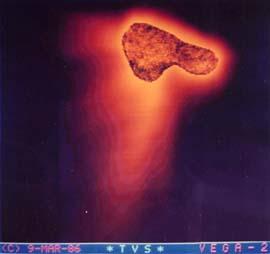
The launches of Vega-1 and Vega-2 took place on December 15 and 21, 1984 on the Proton-K launch vehicle from Baikonur, after 176 and 178 days, respectively, they reached Venus. After the flyby of Venus and the successful descent of the vehicles with balloon probes, Vega-1 and Vega-2 approached the nucleus of Halley's Comet, transmitting images and data on the composition of cometary dust to Earth. Communication with Vega-1 ceased in January 1987, with Vega-2 - in March 1987.
Thanks to these spacecraft:
- on Venus, for the first time with the help of balloon probes, the atmosphere of the planet was studied: the concentration of sulfuric acid in clouds was measured, the presence of sulfur, chlorine and, presumably, phosphorus was found;
- for the first time, images of the comet's nucleus were obtained during the flyby of Halley's Comet;
- for the first time, information was obtained on the chemical composition of cometary dust, the interaction of cometary plasma with the solar wind was studied, the structure, size, infrared temperature of the comet's nucleus were determined, and estimates of its composition were obtained. Thus, it turned out that Halley's Comet has water vapor, atomic and molecular components, as well as metals with an admixture of silicates;
- the European interplanetary spacecraft Giotto was able to approach the nucleus of Halley's Comet at a distance of 600 km during the flyby on the night of March 13-14, 1986. This became possible with the help of refined data from Vega-1 and Vega-2 about the location of the comet in given time intervals.
The project was of great importance for the further development of both Soviet, and then Russian, and international unmanned cosmonautics. And it's not only about the unique scientific data obtained, but also about the experience of cooperation in creating new space equipment, and in the implementation of joint large manned missions by space powers.
Read materials on the topic:
A program for improving navigation in space has been developed in Moscow
The first prototype of a 50-qubit quantum computer based on cold rubidium atoms has been launched in Russia
Vintage but reliable: the Russian Soyuz launch vehicle has been named one of the best in the world
Never miss our newsAdd this site to your preferred sources to see us more oftenAdd on Google

















