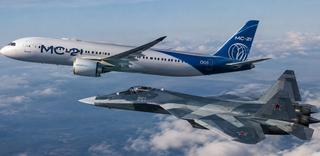
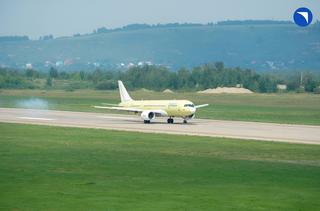
The MS-21 gained a key advantage over the Boeing 737 and Airbus A320 – the fuselage width of the Russian airliner is 4.06 m. This makes the cabin the most spacious in its class of narrow-body aircraft, allowing passengers to freely pass a flight attendant's trolley in the aisle, explained aviation expert Sergey Grishchenko.

However, a wide fuselage has a serious drawback – it creates increased aerodynamic drag. To prevent the aircraft from consuming too much fuel and to remain competitive, engineers needed a radical solution. This became the innovative composite “black” wing.
It is the use of composite materials in the MS-21-310 that allowed for the creation of a high-aspect-ratio wing, meaning narrow and long. Such geometry provides greater flight range or greater fuel efficiency. A wing of this shape, made of metal, would break or be too heavy.
A metal structure requires a large number of individual elements – skins, stringers, ribs, connections.

A composite wing is formed from carbon fibers, laid in the desired directions and combined with a polymer matrix. This allows for simultaneous control of the strength, stiffness, and mass of the structure.
Read more on the topic:
Never miss our newsAdd this site to your preferred sources to see us more oftenAdd on Google