The Russian generative AI market reached approximately 58 billion rubles by the end of 2025 — more than a fourfold increase compared to 2024. The segment of AI agents and related solutions is estimated at 15–25 billion rubles. However, full-fledged multi-agent systems, where several specialized agents coordinate actions and solve problems together, are still far from a mass phenomenon. Roman Konnov, developer of the “FinmarketSoft multi-agent system (AgentSpore EE)” and employee of the IV RAS, commented on the situation in the industry for “Pervy Tekhnichesky” on the sidelines of the “Digital Days of Innopolis” forum.
The market for multi-agent systems and orchestration platforms is growing worldwide. According to some estimates, it was about 4.7–5.8 billion dollars in 2025–2026, with potential growth to 21 billion by 2031. Other studies indicate even more aggressive dynamics — up to tens of billions of dollars by the mid-2030s. Russia occupies a small share of the global multi-agent market but is already forming its own specifics, including sovereign AI models and data that can be deployed without constant recourse to external services.
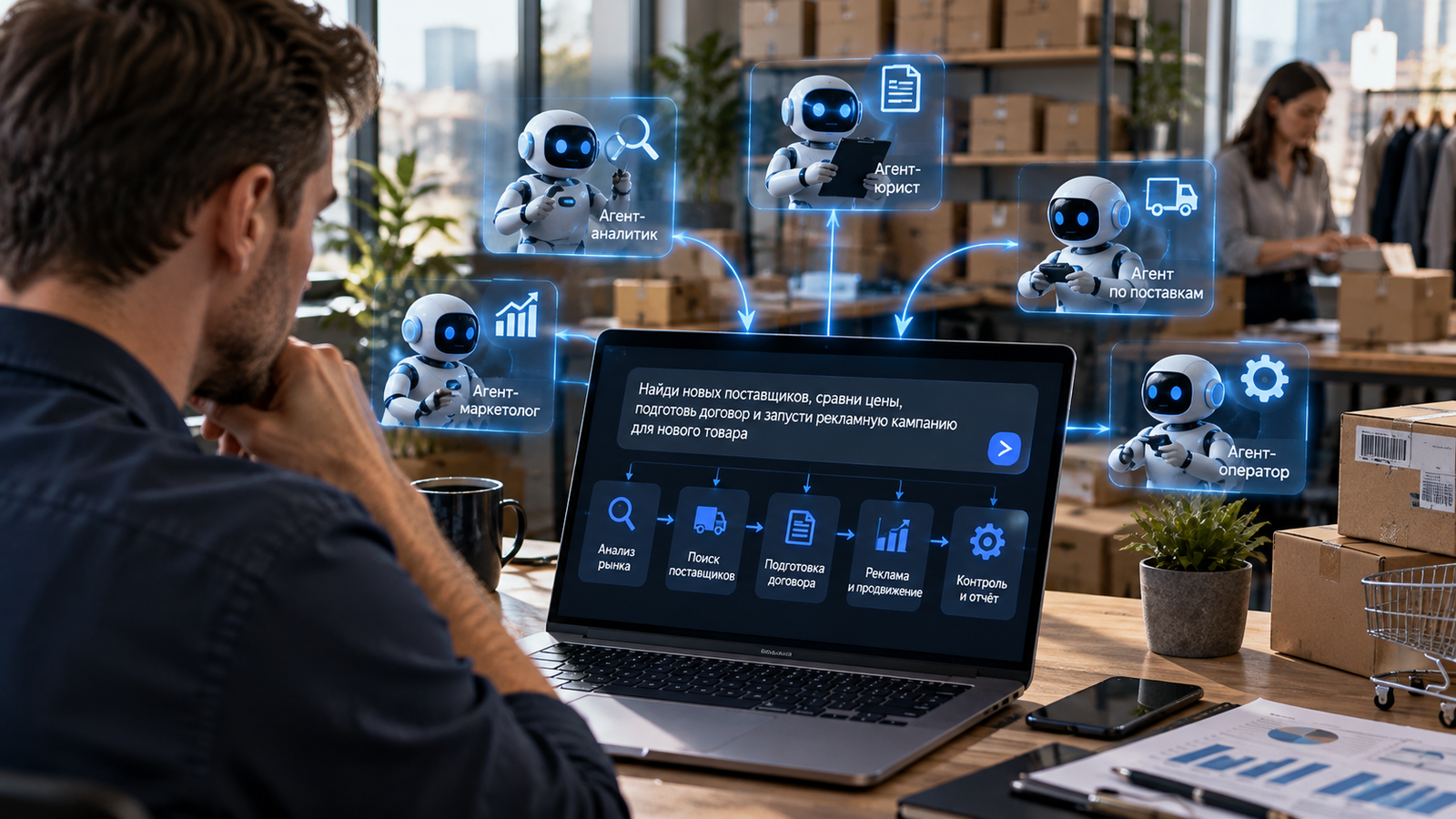
In multi-agent platforms, agents work together, evaluate each other's results, and organize entire workspaces. This direction can be especially valuable for small and medium-sized businesses.
The User Sets the Task, and the Multi-Agent System Assembles a Department to Solve It
The multi-agent developer explained the logic of the AI solution. In the Russian market, most existing solutions are still experimental. But even now, agents are being integrated into the interaction and production and technical processes of small and medium-sized businesses.
The user enters their task, and in the multi-agent system, agents assemble the entire flow, create new colleagues for themselves, test the results of the task execution, and provide the user with a specific result. The scope of application can be absolutely anything — from document management and information gathering to supply planning for an individual entrepreneur or tasks for a small store.
Small and medium-sized businesses can integrate a multi-agent platform, deploy it in a few minutes, and use it for their tasks; solutions for this are already on the market, the developer noted.
Working with local models is another important issue. Many enterprises are preparing local solutions so that everything remains on the employees' laptops. Especially in cases where the business is not ready to give data to external companies.
How a Multi-Agent System Differs from a Regular AI Agent
The evolution of tools goes from simple assistants to AI agents with tools, hooks, and more complex orchestration.
A multi-agent system allows you to configure interaction between agents. Each agent is responsible for its role. This can be a developer agent, a tester agent, a data analyst agent, and so on. The distribution of load and roles among agents allows for building a more complex client flow for a specific task, using small models.
If an entrepreneur lacks developers, SMM specialists, and other competencies, they can use multi-agent systems. Plugins for clients have already been developed in Russia, but the Russian multi-agent market is still in its infancy. For SMEs, as the developer noted, a low entry threshold, the possibility of local deployment, and the absence of strict dependence on external providers are especially important.
How Russian Companies Implement Multi-Agent AI Systems
According to a study by Infosystems Jet and Smart Ranking, published by CNews in August 2026, multi-agent solutions are implemented by 23% of large Russian companies, but they have reached industrial operation in only 8% of organizations. Among the obstacles to implementation, researchers cite insufficient maturity of business processes, data problems, and difficulties in integration with corporate systems.
Roman Styatyugin from VK Tech also previously spoke about the need to control the work of several AI agents. In June 2026, the company announced support for multi-agent systems on the VK AI Space platform. In such an architecture, the lead agent coordinates the work of the others, and specialized agents perform individual tasks.
Read more on the topic:
Never miss our newsAdd this site to your preferred sources to see us more oftenAdd on Google