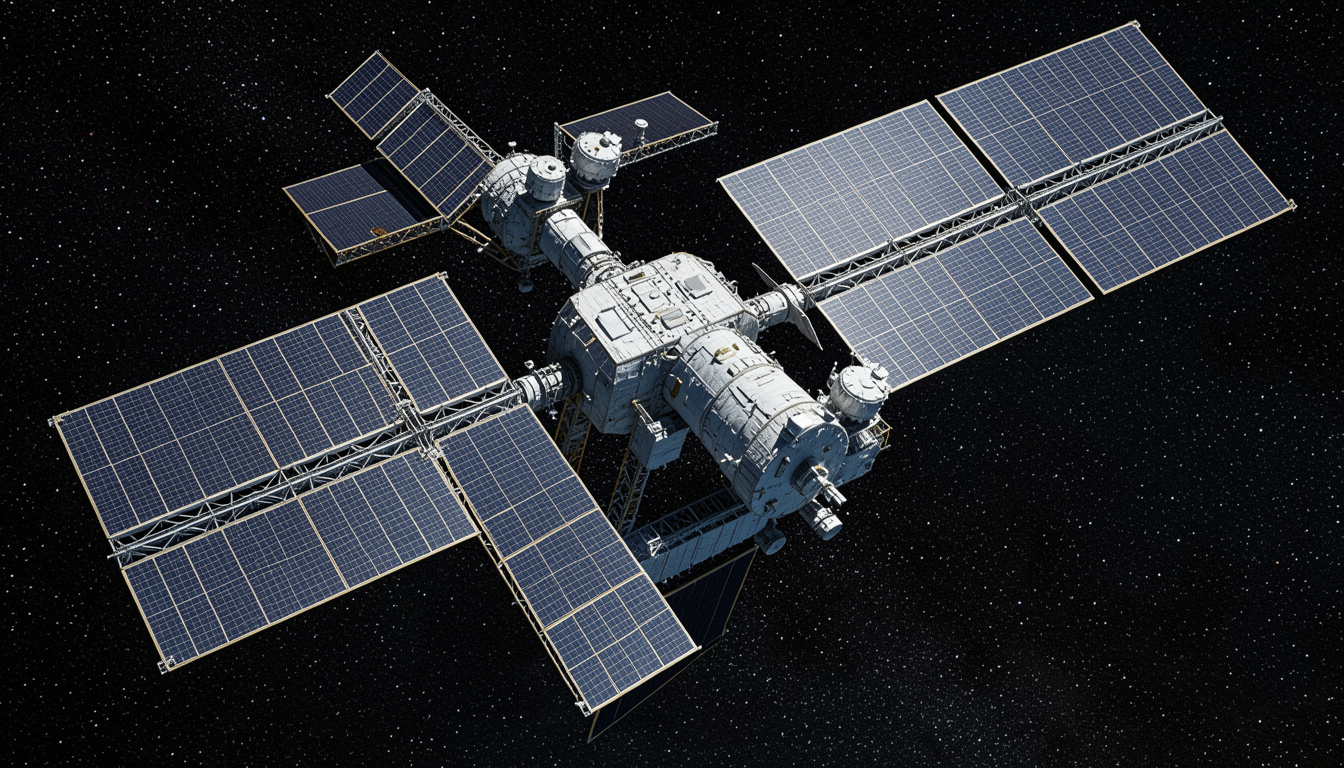
President of the Kurchatov Institute, Mikhail Kovalchuk, announced that the Russian Orbital Station (ROS) will receive specialized modules for 3D printing. The technology will allow the creation of structural materials, living tissues, and medicines using space conditions — deep vacuum and microgravity.
The scientist noted that additive methods mimic natural processes: instead of mechanically removing excess material, as in traditional production, where up to 80% of raw materials go to waste, 3D printing forms the product layer by layer from the initial components.
The space environment, according to Kovalchuk, is ideal for growing protein crystals without structural defects. This will simplify the study of viruses and the development of highly purified drugs. The absence of gravity and convection also allows obtaining semiconductor crystals of increased purity — the basis for energy-efficient neuromorphic and cryoprocessors of the future.
The Kurchatov Institute, together with Rosatom and Roscosmos, has already created the Center for Additive Technologies, where they produce powder materials for 3D printing and develop specialized equipment. The plans include equipping ROS with installations for printing spare parts directly in orbit, which will reduce dependence on terrestrial supplies.
The day before, the president of the Kurchatov Institute, Mikhail Kovalchuk, announced that the prototype of the Russian lunar nuclear power plant "Selena" will appear by 2032. The institute is developing a 5 kW installation based on direct energy conversion technology.
Read more on the topic:
Never miss our newsAdd this site to your preferred sources to see us more oftenAdd on Google

















