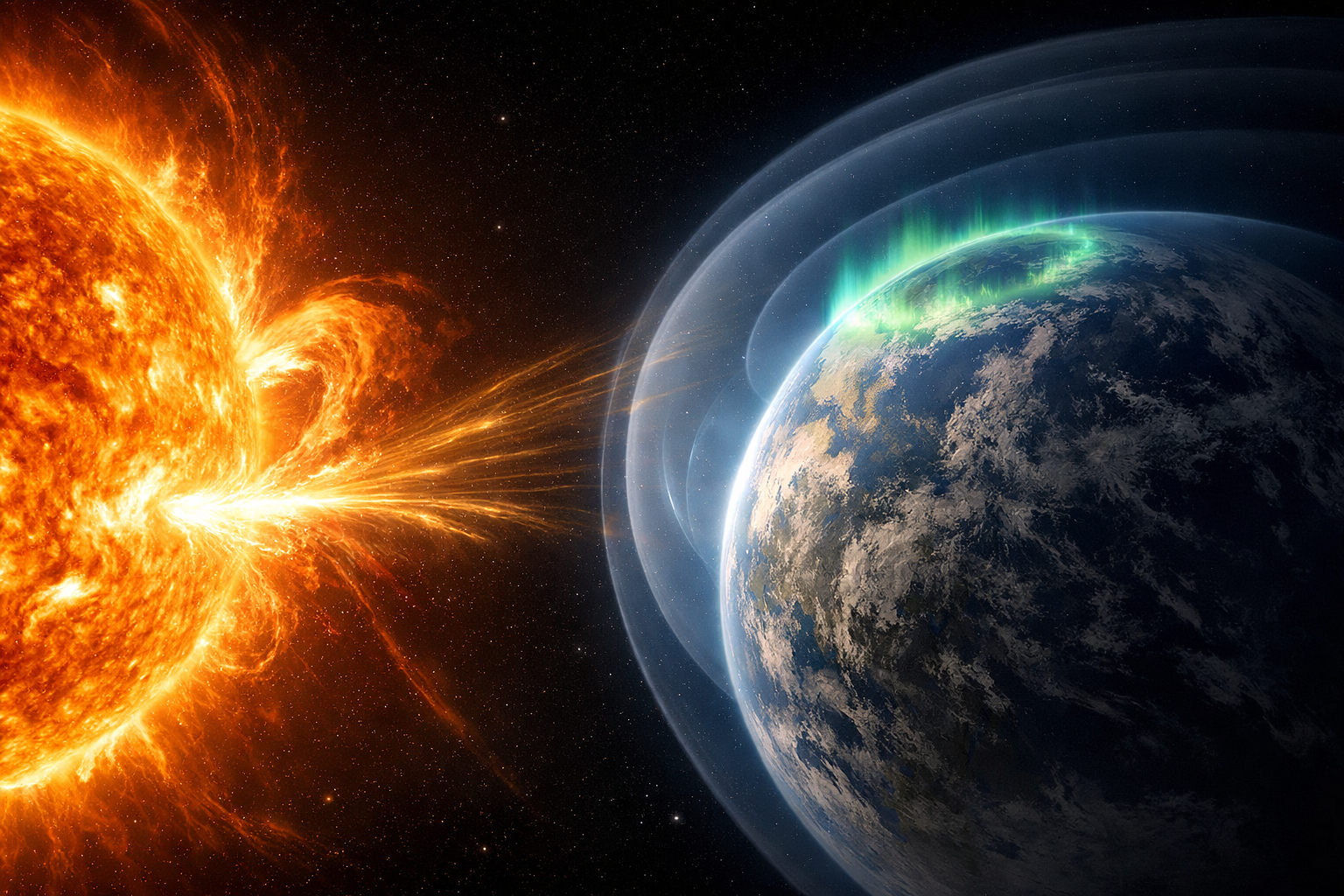
Solar activity on Saturday, April 4, is declining after a powerful M7.6 class night flare. The current value is C1.23, the last recorded flare is C2.2 with a peak at 06:30 Moscow time. The data is provided by the Spaceweatherlive portal. Despite the decrease in activity, the geomagnetic storm continues: the plasma cloud from the preceding coronal ejection has already reached Earth. The Laboratory of Solar Astronomy of the Institute of Space Research of the Russian Academy of Sciences (IKI) and the Institute of Solar-Terrestrial Physics (ISZF) reports on the intensification of storms and the increase in the intensity of auroras at high latitudes. Full normalization of the situation is expected no earlier than Sunday, April 5.
How activity developed during the night and morning of April 4
The most powerful event of the day — the M7.6 flare — occurred between 04:07 and 04:23 Moscow time. After it, activity consistently decreased: C1.7 with a peak at 05:58 Moscow time, then C2.2 with a peak at 06:30 Moscow time.
C-class flares are weak, they practically do not affect ground infrastructure, however, against the background of the already arrived plasma cloud, the geomagnetic situation remains unstable.
Geomagnetic disturbances began on April 2 — they were triggered by a new coronal hole on the Sun. A coronal hole is an area of the solar corona with a weakened magnetic field, through which the solar wind escapes at an increased speed.
Radiation load on Artemis II
Against the background of current activity, the Artemis II mission — a manned flyby of the Moon — is taking place in conditions of increased radiation background. The number of heavy particles in near-Earth space, including protons with energies above 10 MeV, has increased by about ten times compared to background values. As of publication, NASA has not made any official statements about the impact of the radiation environment on the progress of the mission.
Read more materials:
- Domestic station "Venera-D" will receive images of the surface of Venus for the first time since the 80s
- Exhibition in the clouds: Roscosmos will show spacecraft and cargo ships at an altitude of 300 meters
- Solar panels of "Progress MS-34" successfully passed pre-launch tests
Never miss our newsAdd this site to your preferred sources to see us more oftenAdd on Google