Translated with AI from the Russian original.
Powerful explosions continue on the far side of the Sun. According to the Laboratory of Solar Astronomy of IKI RAS and ISZF SB RAS, a new event occurred today around midnight Moscow time. Presumably, its source was sunspot group 4436, which was opposite Earth about 10 days ago but showed no significant activity then.
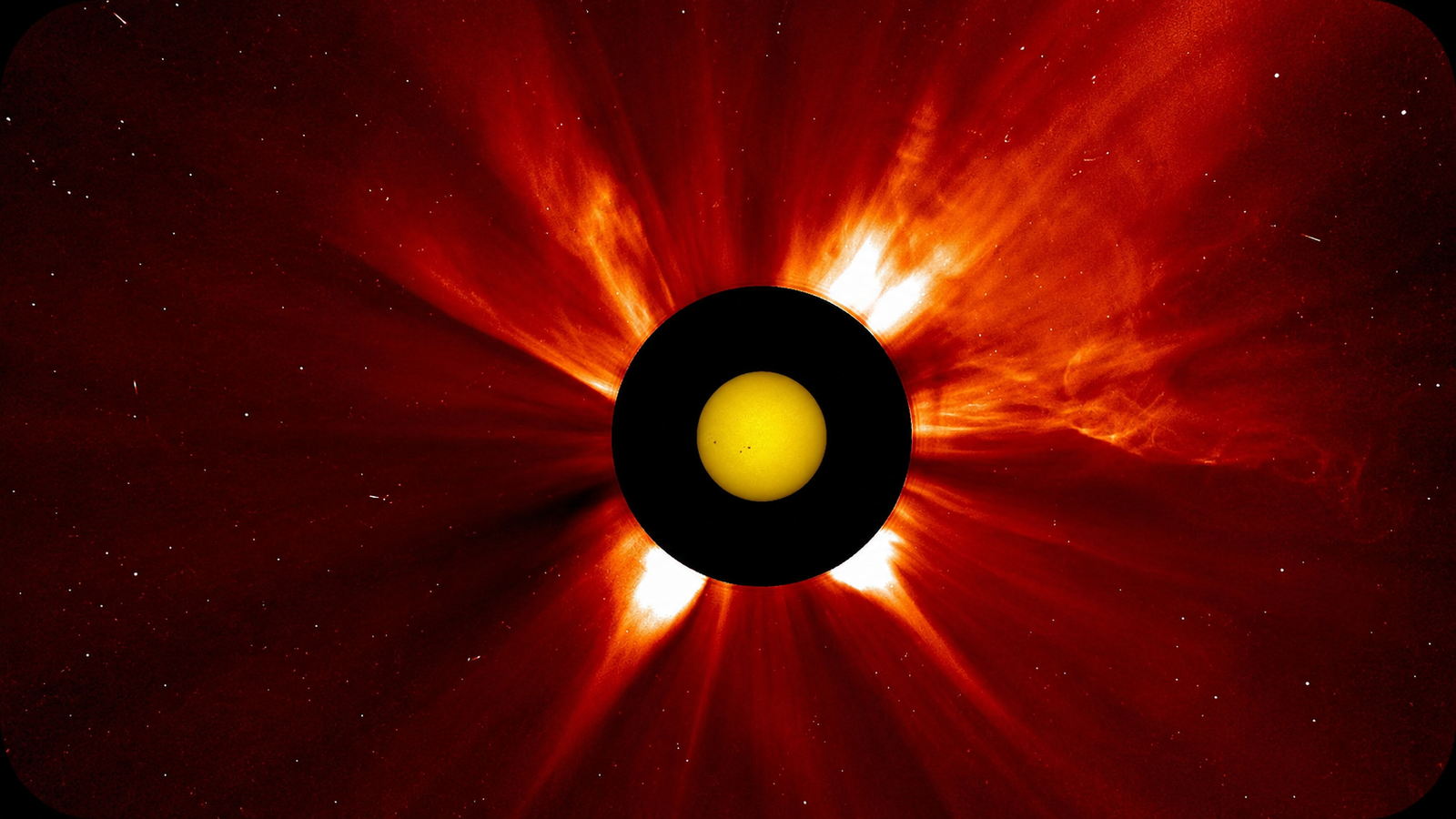
The most unusual aspect of this episode is its potential impact on near-Earth space. According to preliminary data, the plasma ejection could have partially affected Earth, despite the explosion itself occurring on the far side of the Sun. Currently, a moderate radiation storm is being recorded in the vicinity of the planet, and high-energy proton fluxes have reached levels that trigger warnings.
The increase in particle count roughly coincided with the solar explosion. Additionally, proton fluxes passed through the solar coronagraph that captured the event: they appeared as bright point flashes and streaks – a kind of "snow" in the frames.
The Laboratory of Solar Astronomy calls the situation atypical and continues to investigate the mechanism of the event. Theoretically, the radiation storm could be linked to another explosion on the visible side of the Sun, but no signs of such an event have been found yet. Therefore, the main hypothesis currently is that protons indeed reached Earth after an explosion from the far side, effectively bypassing the Sun.
Meanwhile, large sunspots that were previously on the far side have been emerging onto the Earth-facing half of the solar disk for about two days. While they are not showing strong activity yet, the situation continues to be monitored.
Read more on the topic:
Never miss our newsAdd this site to your preferred sources to see us more oftenAdd on Google

















