Translated with AI from the Russian original.
Since its discovery, comet C/2026 A1 (MAPS) has already increased in brightness by a factor of 30. Over the next week and a half, its luminosity is expected to double again. Such a sharp surge is linked to its approach to the Sun: the closer the celestial body gets to the star, the more actively volatile substances evaporate, forming a larger and more reflective tail. This was reported by the Laboratory of Solar Astronomy of the Space Research Institute of the Russian Academy of Sciences and the Institute of Solar-Terrestrial Physics of the Siberian Branch of the Russian Academy of Sciences.
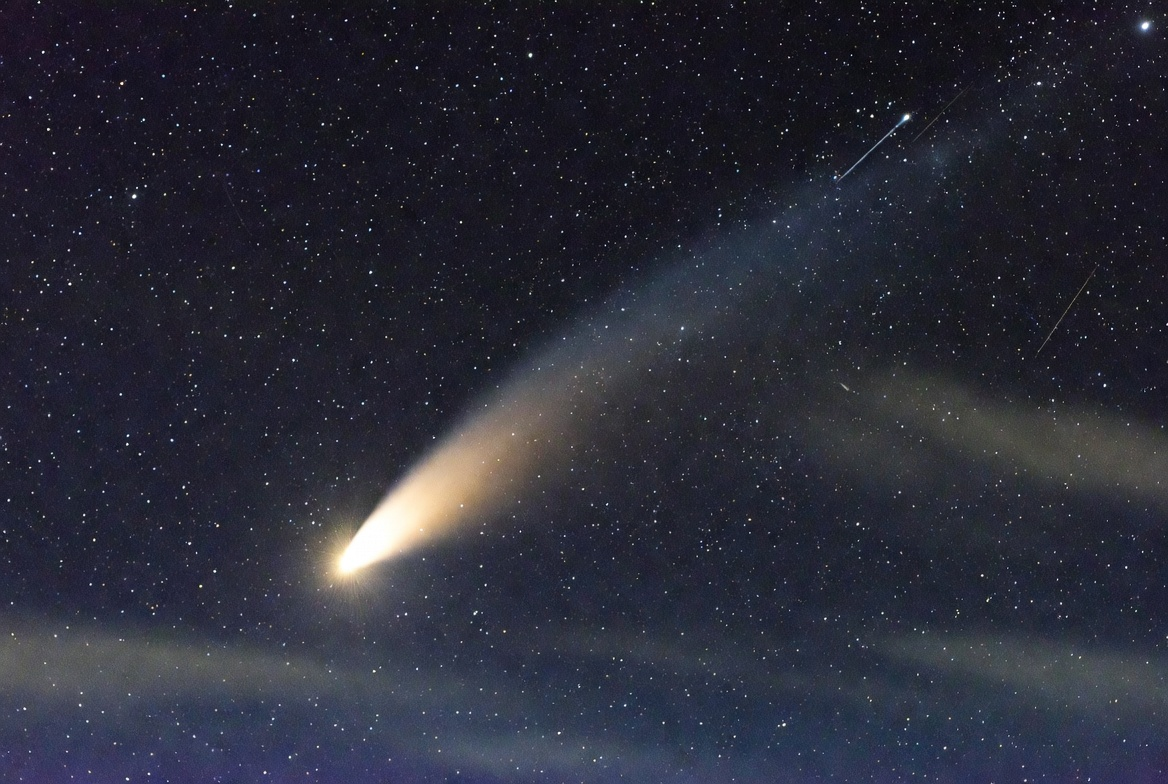
As specialists explained, three to four days before the estimated date of closest approach to the Sun — April 4, 2026 — the comet may become observable with the naked eye. Moreover, not only at twilight, but also against the daytime sky. The growth of the tail's area combined with increased solar illumination will create conditions for an "explosive" increase in visible brightness.
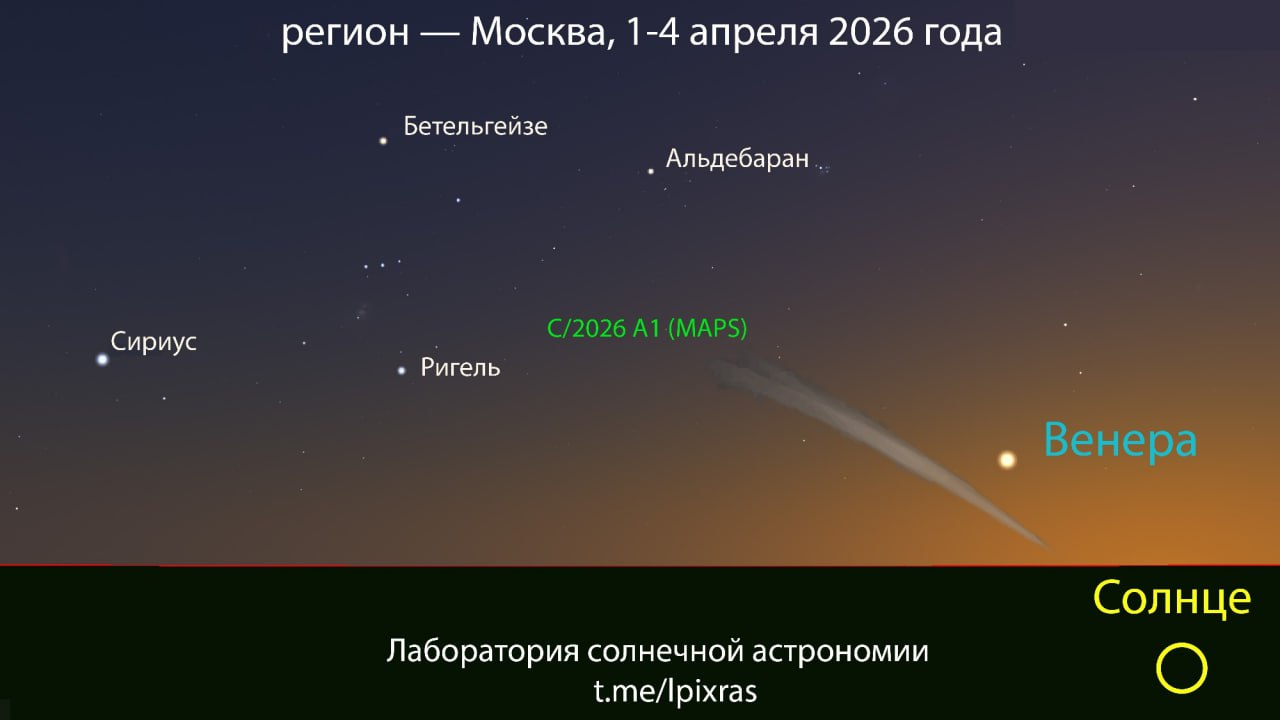
It will most likely be possible to observe the phenomenon from the territory of Russia as well — provided the weather is clear and horizon light pollution is minimal.
Exactly one month after the publication of the forecast, on April 4, 2026, the comet will reach the point of maximum approach to the Sun. Scientists expect that it will not withstand the extreme heating in the solar corona and will evaporate, like a drop of water, while still on approach — at a distance of several hundred thousand kilometers from the visible surface of the star. In fact, this will not be a "fall" in the classical sense, but thermal destruction in the plasma environment of the corona.
Read more materials on the topic:
- Get your telescopes ready: comet 24P/Shomassa will pass at its minimum distance from Earth
- Comet 3I/ATLAS was called Russia's secret weapon
- The Sun destroyed two comets in a matter of hours: astronomers recorded a rare cosmic phenomenon
Never miss our newsAdd this site to your preferred sources to see us more oftenAdd on Google

















