Translated with AI from the Russian original.
The Institute of Automation and Electrometry of the Siberian Branch of the Russian Academy of Sciences, together with Novosibirsk State University, created a new VR simulator. It will help cosmonauts learn to photograph Earth the way they do it on the International Space Station. The conditions on the simulator are very similar to real ones.
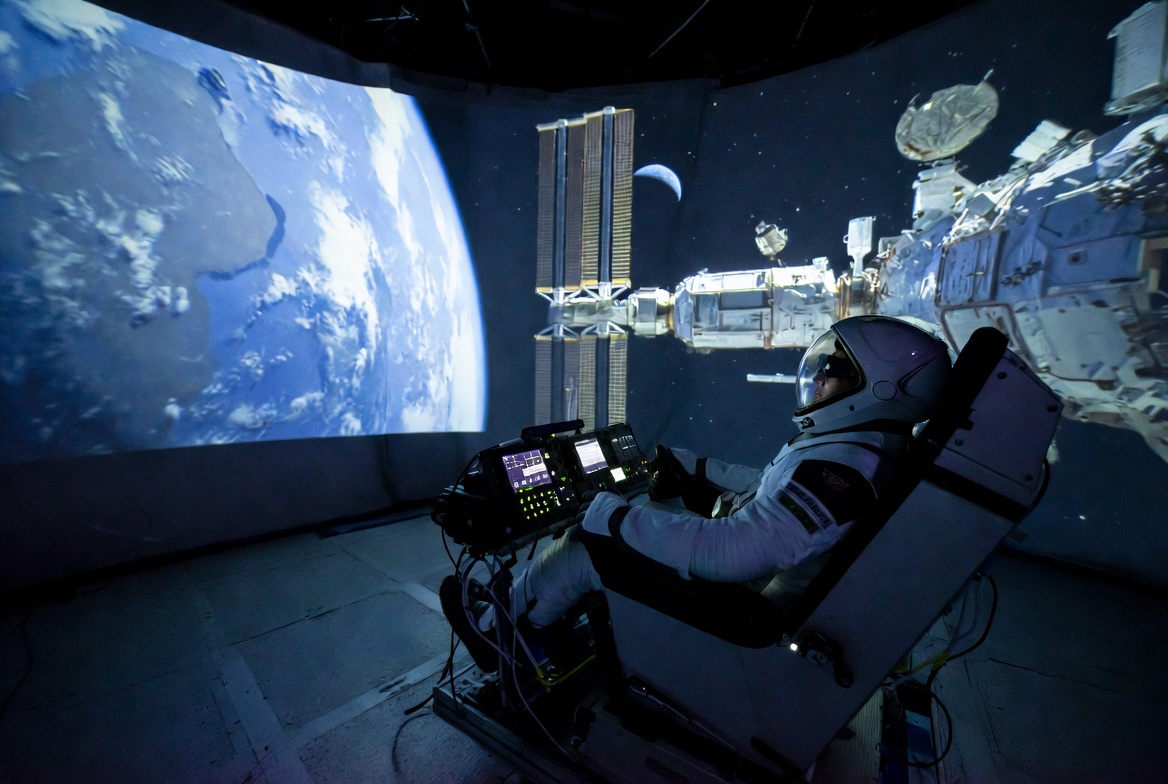
As reported by IA&E SB RAS Deputy Director and Dean of the Faculty of Information Technologies at NSU Mikhail Lavrentyev, the main difficulty of orbital photography lies in the extremely limited time available - only about 30 seconds - and the small size of the porthole. During this short interval, the cosmonaut must identify the target object, aim the camera, and take the shot. At the same time, because of the long focal length of the lens, the field of view narrows sharply, and even if the object is detected visually, finding it in the frame becomes a non-trivial task.
To solve this problem, specialists created a telephoto lens simulator with a microdisplay built into it, visible through the camera eyepiece. To make the sensations closer to reality, shot was added to the design, increasing the device's inertial characteristics and simulating the weight and inertia of a real camera.
Orientation sensors are installed on the telephoto lens, transmitting data to a computer that forms the image on the microdisplay in full accordance with the current shooting direction. Thus, when the camera's aiming angle changes, the image on the display is updated instantly.
Additionally, the cosmonaut uses a helmet with sensors that track head position. The system determines where the user is looking and adjusts in real time the image displayed "behind the porthole." The entire visualization is updated at 50 frames per second, ensuring high fidelity and smooth interaction.
Read more materials on the topic:
- High above the ground: a VR simulator for crane operators was showcased at the "Cloud Cities" forum
- A VR simulator for election observers was presented in Moscow
- The Shipping Register approved a VR simulator for training specialists in receiving helicopters at sea
Never miss our newsAdd this site to your preferred sources to see us more oftenAdd on Google

















