At the "Krasnoye Sormovo" plant of the United Shipbuilding Corporation (USC), a solemn ceremony was held for the laying of the fourth serial dry cargo vessel under project RSD59. A commemorative закладная доска was installed on the first section, indicating data about the country of origin, the shipyard, the project name, the construction number, and the date of the vessel's laying.
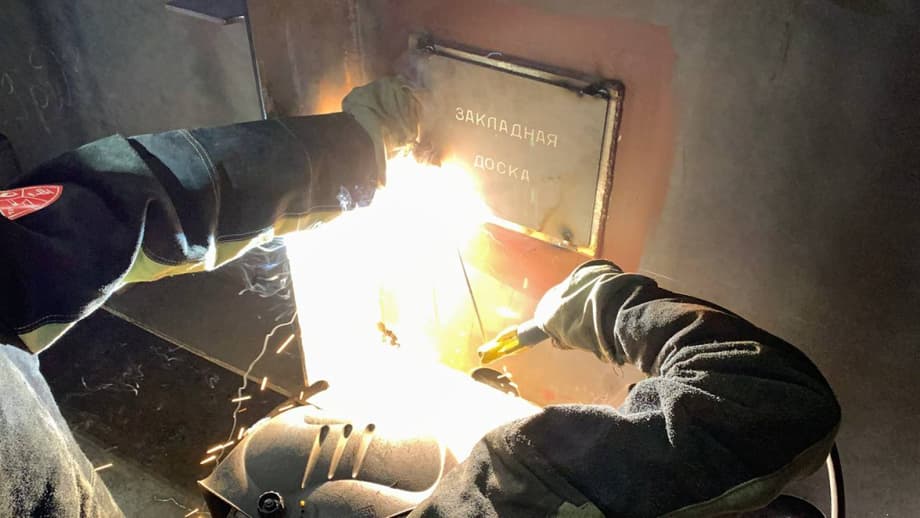
The laying process took place in the hull-assembly production workshop, after which this section will be sent to the slipway to form the hull. The working drawings for the dry cargo vessel were developed by the Volga-Caspian Design Bureau of USC.
The self-propelled single-deck vessel of project RSD59 is designed for sea and mixed (river-sea) transportation. It has two cargo holds and two full- поворотный screws with a steering column. The vessel has the ability to transport various cargoes: general, bulk, packaged lumber, round timber, scrap metal, rolled metal, as well as oversized, long, and heavy items, coal, dangerous goods, and goods of category "B".
Project RSD59 has established itself as one of the most sought-after due to its versatility and reliability. Dry cargo vessels of this model can use both sea and inland waterways, including limited navigation areas.
As a result of a large-scale modernization, USC "Krasnoye Sormovo" will significantly increase its production capacity and switch to large-block serial construction, which will subsequently allow the production of up to 20 dry cargo vessels per year.
Read more materials on the topic:
Now on home

Start of deliveries scheduled for 2027

Over 51,000 new motorcycles were sold in Russia in 2025

The car will take at least a year to assemble

The application's audience has reached 20 million users

The model will be included in the list of cars for taxis, price - from 2.25 million rubles

All parking lots of the "Administrator of the Moscow Parking Space" are connected to the service

The cars will be supplied to the Moscow Transport Service Directorate

Deliveries to India may begin in 2028

The technology provides automated search for all types of defects in power units

The plane flew 500 km, accelerating to 425 km/h

The plant stated that the information about the termination of purchases for models 6 and 8 is not true

Scientists are using the "Ekran-M" installation