Researchers from the Institute of Chemistry of High-Purity Substances of the Russian Academy of Sciences have developed an innovative optical fiber. It features record low energy losses, surpassing existing analogs by five times. This development will find application in creating more powerful lasers, in microsurgery and ophthalmology, as well as in the production of high-precision sensors for monitoring harmful gases in the environment.
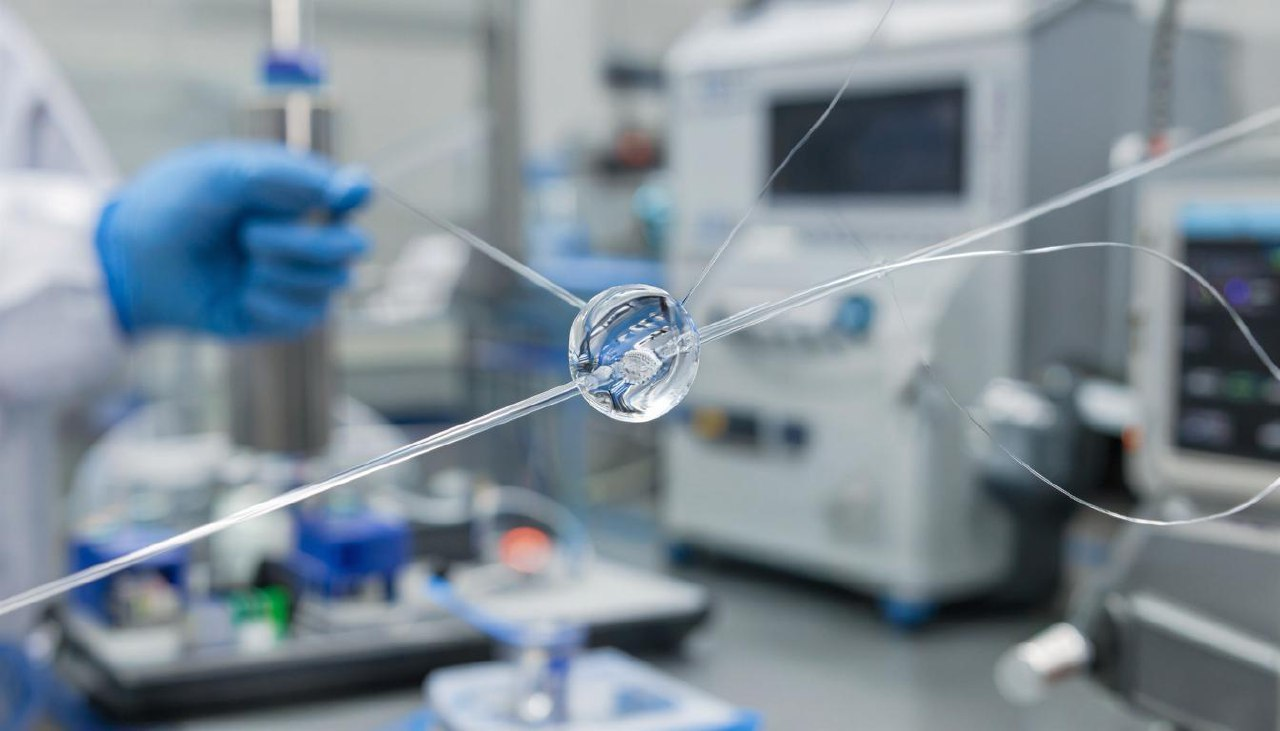
The obtained characteristics of the optical fiber are an important technological result that brings us closer to the practical use of telluride waveguides in real devices for the infrared range.
Optical fiber is a thin glass thread that provides light transmission over significant distances. Fibers operating in the infrared range with wavelengths of 9.3 and 10.6 micrometers are particularly in demand in medicine: they are used in lasers for high-precision neurosurgery and ophthalmological operations, reducing risks and increasing accuracy due to the absence of bulky mirror systems. The new development will significantly improve the efficiency of such medical technologies.
Read more materials:
Now on home

Start of deliveries scheduled for 2027

Over 51,000 new motorcycles were sold in Russia in 2025

The car will take at least a year to assemble

The application's audience has reached 20 million users

The model will be included in the list of cars for taxis, price - from 2.25 million rubles

All parking lots of the "Administrator of the Moscow Parking Space" are connected to the service

The cars will be supplied to the Moscow Transport Service Directorate

Deliveries to India may begin in 2028

The technology provides automated search for all types of defects in power units

The plane flew 500 km, accelerating to 425 km/h

The plant stated that the information about the termination of purchases for models 6 and 8 is not true

Scientists are using the "Ekran-M" installation