Scientists at Perm National Research Polytechnic University (PNRPU) have developed a model based on the theory of solar dynamo. It analyzes the cyclic evolution of magnetic fields, allowing to predict the activity of the Sun for 11 years ahead. As the scientific supervisor of the project, Georgy Tashkinov, explained:
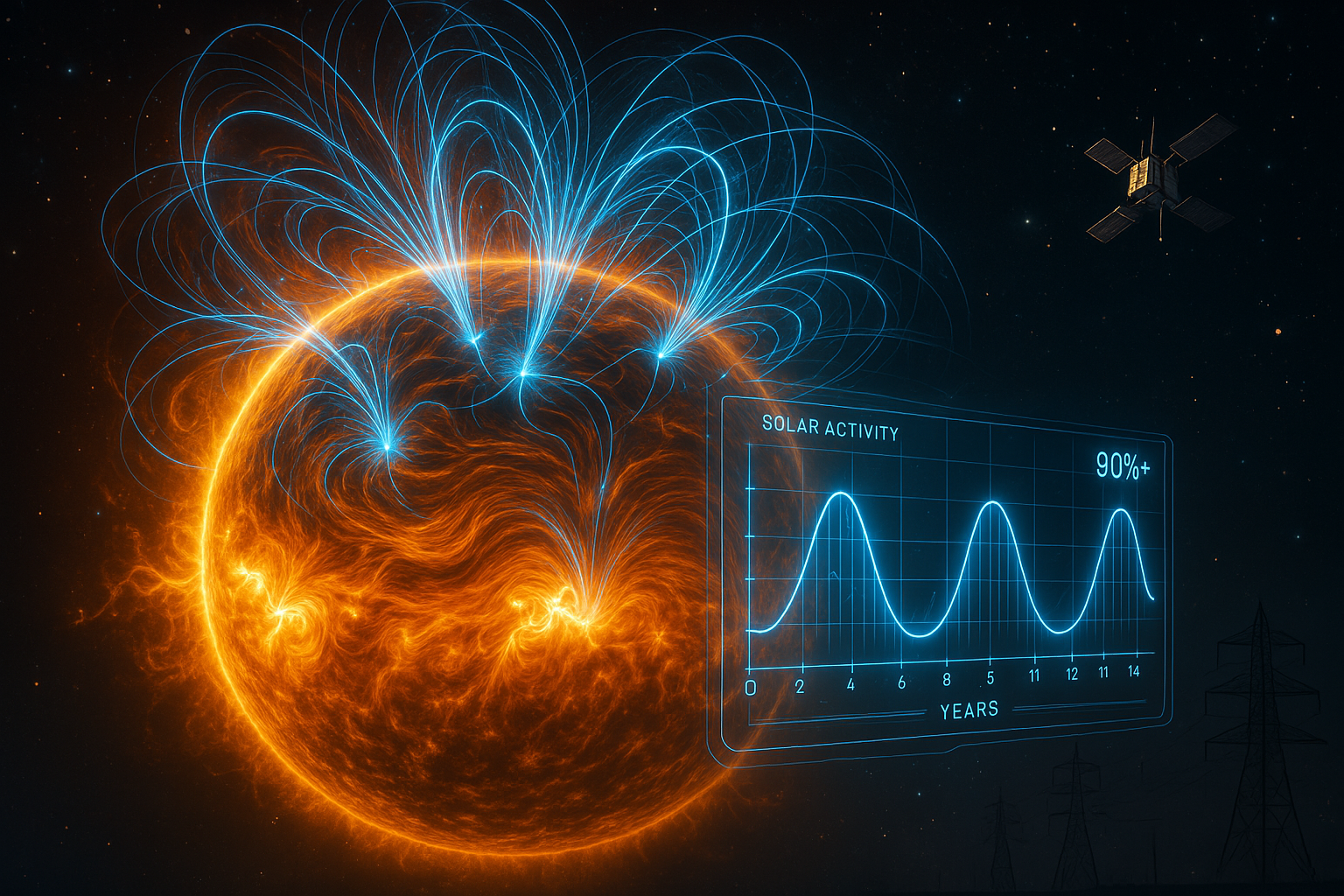
The Sun is not a solid body; it consists of a hot plasma that can move relative to other layers and regions. Due to this movement, magnetic fields are formed and maintained. They, in turn, are constantly changing, rotating, and stretching either along the Sun's equator or across it. This entire process is called the solar dynamo, which approximately every 11 years ensures the cyclic formation, amplification, and change of the magnetic field, as well as affects the appearance of spots and flares on the Sun. Our model is based on equations that describe these processes and thereby allow us to reproduce this 11-year solar cycle, providing a long-term and accurate forecast.
The effectiveness of the model is confirmed by comparison with historical data for 40-50 years. The accuracy exceeds 90%. The implementation of the development will allow timely adjustment of the operation of satellites, power systems, and air routes. The next stage is the integration of new type neural networks (Physics-Informed Neural Networks), which, unlike ordinary neural networks, will be based on fundamental equations of magnetohydrodynamics. Professor Rodion Stepanov noted:
This will allow creating forecasting models that are not only statistically accurate but also physically meaningful. We expect that this approach will significantly increase the reliability of medium and long-term forecasts and give us a deeper understanding of the physics of the solar dynamo.
The model is already ready for scientific and applied use, strengthening the resilience of technologies to space impacts.
Solar flares and coronal mass ejections can cause geomagnetic storms that disrupt the operation of satellites, power grids, and communication systems. Traditional forecasting models are limited to short-term intervals-from 6 hours to 6 months-and do not take into account complex physical processes inside the Sun, such as plasma dynamics and the evolution of magnetic fields. This reduces the accuracy of long-term predictions, which are critical for infrastructure protection.
Read more materials on the topic:
A giant prominence captured on the Sun: Russian astronomers shared images on the web











