Translated with AI from the Russian original.
Scientists from Samara University named after Korolev presented an upgraded version of a photonic computer capable of processing video streams hundreds of times faster than traditional digital neural networks. The device, which operates on the principles of analog optical data processing, showed a 50% increase in energy efficiency and a 1% increase in recognition accuracy.
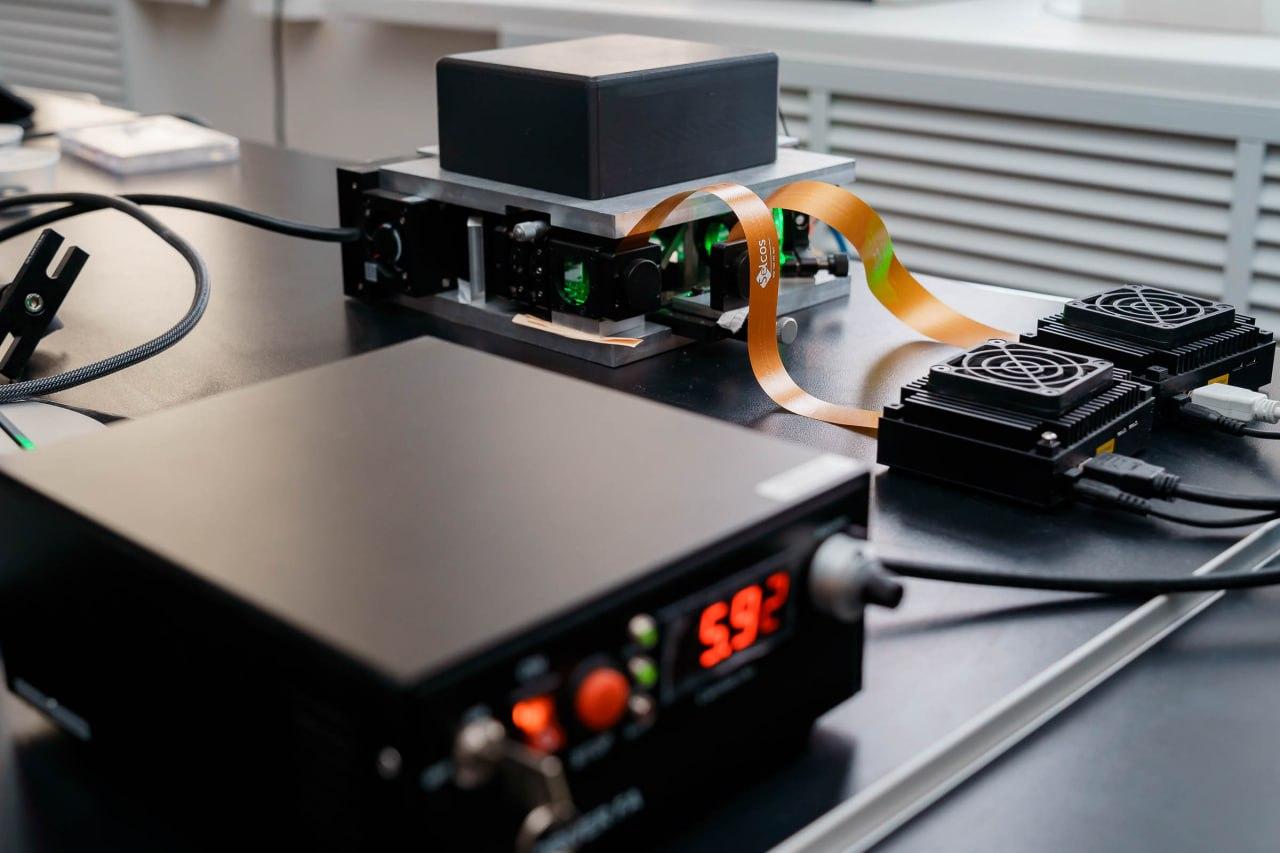
The point here, of course, is not about saving electricity, but about the efficiency of calculations, this parameter is one of the key ones for computing devices. In addition, the number of errors has decreased, the recognition accuracy has increased by about 1%. By applying phase input, we removed some elements of the design associated with processing the intensity of the optical signal. The design has become simpler, hence fewer possible sources of errors in calculations. Considering that we are already very close to 100%, each new step to increase accuracy is a very difficult task, at this level an increase of 1% is a very significant indicator.
The key change in the new version was the transition from amplitude to phase input of the optical signal. As Professor Roman Skidanov explained, this made it possible to simplify the design and reduce the number of errors in calculations.
It turned out that it is no worse than the traditional amplitude one, and for some tasks even much better.
With phase input, the computing device performs phase modulation of the electromagnetic wave that carries the image of the object under study. This means that information about the image is encoded not by the intensity of light, but by the phase of the wave. This is similar to various types of modulation in broadcasting: amplitude modulation is used on medium and long waves, and frequency modulation is used in the FM band.
A neural network operating using a photonic computer is capable of analyzing the video stream entering the system in real time. Due to the high data processing speed, comparable to the speed of input/output devices, it can quickly recognize and find objects and images in the video stream that need to be detected. In addition to analyzing video from a regular camera, the development can also quickly process data obtained using hyperspectrometers. These devices allow you to see reality in a multi-channel spectral display and detect objects that are not visible to conventional means of observation.
Currently, the university is actively working on creating a prototype of a photonic computer. This sample will be created on the basis of an experimental model and, according to the developers, will become an almost pre-production product. The development was presented at the Sarov Technology Park as part of a visit by the Chairman of the Government of the Russian Federation. The project is being implemented with the support of the NCFM, the Ministry of Education and Science and Rosatom.
Optical computing systems operating on the basis of analog technologies have a number of advantages, in addition to high processing speed and a wide frequency range. They are completely protected from electromagnetic interference, consume little energy and allow data to be processed in parallel.
Read more materials on the topic:
Technology for recognizing devices based on the "radiogenome" was developed by scientists at RTU MIREA
Temperatures under control: high-precision climate systems equipped the Russian synchrotron SKIF
Method for controlling terahertz waves using a magnetic field developed by scientists at RTU MIREA
Never miss our newsAdd this site to your preferred sources to see us more oftenAdd on Google

















