Researchers at Samara State Technical University (SamSTU) have developed an innovative nanostructured material that combines the characteristics of ceramics and metal. This development is promising for the production of heating elements and medical implants.
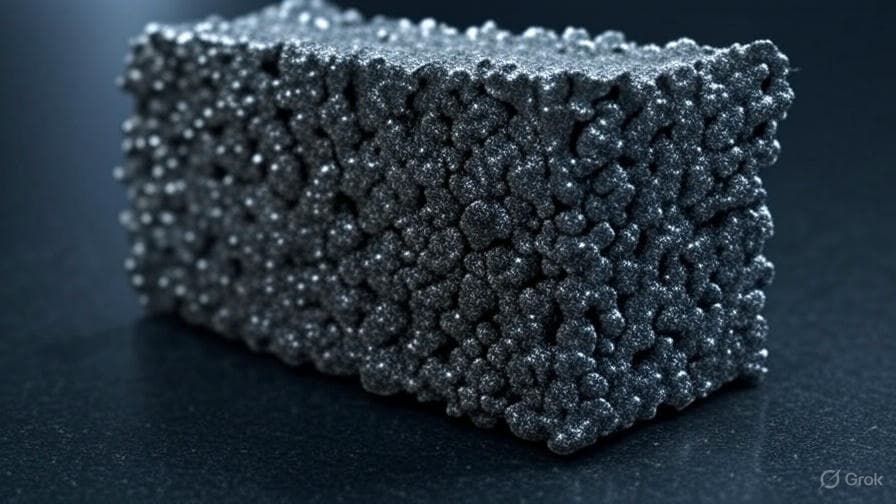
The university's research team has modeled and synthesized a new inorganic material based on the MAX phase of titanium carbosilicide (Ti3SiC2) with partial replacement of silicon by copper atoms. MAX phases are a special class of layered ceramic materials that exhibit a unique set of metallic properties.
The key properties of MAX phases are due to their atomic layered structure. These materials are characterized by high elasticity, strength, corrosion resistance, excellent thermal and electrical conductivity. They also have a low coefficient of thermal expansion, plasticity, friction resistance, thermal stability, heat resistance, and some have increased resistance to fatigue and oxidation.
To obtain a pure MAX phase, the scientists used an environmentally friendly method of self-propagating high-temperature synthesis. Then the material was modified in a furnace, where copper atoms were introduced into the nanolayered structure of titanium carbosilicide, replacing up to half of the silicon content. The researchers managed to create and experimentally confirm a stable phase of copper-containing titanium carbosilicide (Ti3Si0.93Cu0.07C2).
The new material is considered promising for use as refractory or structural materials. It can be used for high-temperature coatings of electrical contacts, in the production of heating elements, medical implants for bone tissue, and in tribology (the study of friction and wear).
Read materials on the topic:
Unique self-healing polymers created at MSTU
Will protect rockets at temperatures above 2300°C: MAI is developing a unique material
Heat-resistant material with rare earth metals for power plants created in Tomsk
Now on home

Start of deliveries scheduled for 2027

Over 51,000 new motorcycles were sold in Russia in 2025

The car will take at least a year to assemble

The application's audience has reached 20 million users

The model will be included in the list of cars for taxis, price - from 2.25 million rubles

All parking lots of the "Administrator of the Moscow Parking Space" are connected to the service

The cars will be supplied to the Moscow Transport Service Directorate
Deliveries to India may begin in 2028

The technology provides automated search for all types of defects in power units

The plane flew 500 km, accelerating to 425 km/h

The plant stated that the information about the termination of purchases for models 6 and 8 is not true
Scientists are using the "Ekran-M" installation