At Yaroslav the Wise Novgorod State University, artificial intelligence models have been developed that recognize the frames of faces and their key points in photographs. These technologies will form the basis of an eye-tracking system - a device that allows you to control a computer with your gaze. It is especially important for people with disabilities.
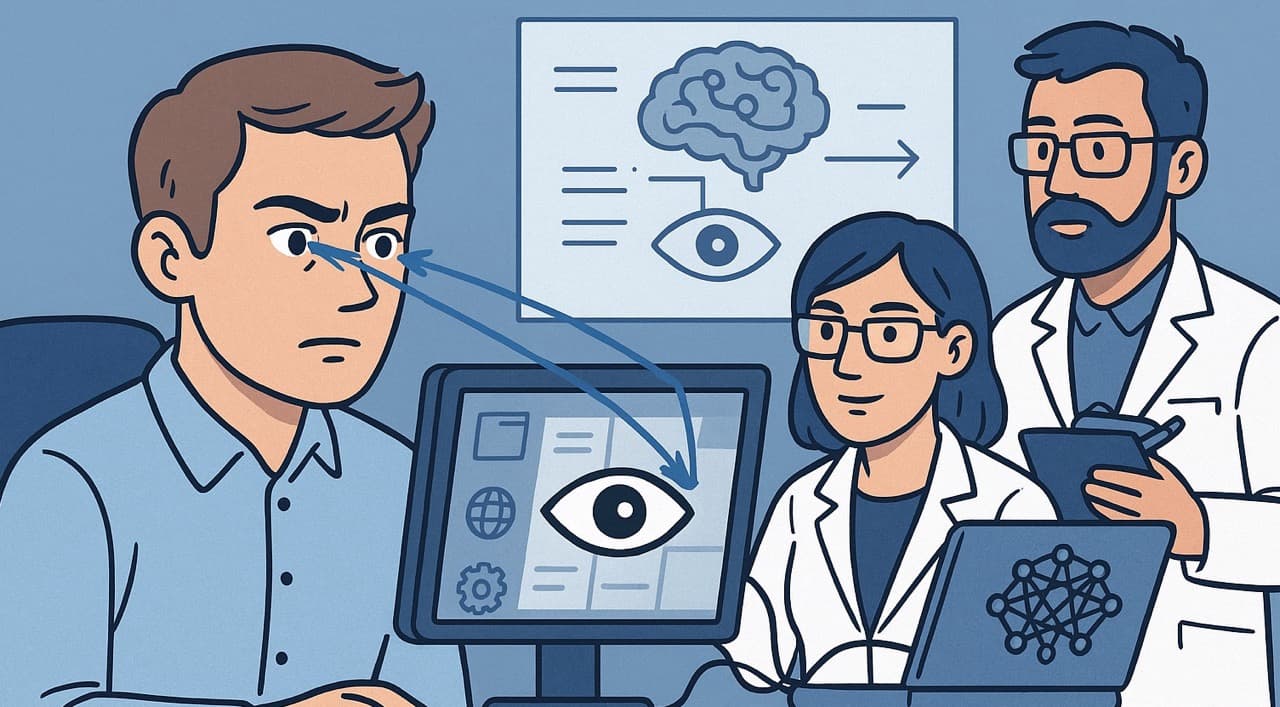
The first model determines the boundaries of the face, the second - key points: eyes, eyebrows, nose, and mouth. Together, they form a neural network system that recognizes the face, cuts out the desired fragment, and reads biometric parameters. Refined datasets from open sources were used for training. On a closed test dataset, the accuracy of face recognition was 87%, and the deviation in determining key points was less than two pixels in a 96×96 pixel image.
Currently, the development team is preparing to assemble a new dataset and create a third model that will predict the direction of gaze on the screen. The finished software prototype is planned to be presented in early 2026. The development is being carried out by Artem Alekseev and Valentin Baranov.
Previously, a team led by Igor Kulakov had already created a prototype neural network for recognizing hand gestures, and is now working on a model for processing voice commands. All these solutions will be integrated into the eye tracker. According to Kulakov, existing analogues are not yet accurate enough, and the team hopes to improve them through modern machine learning tools.
Read materials on the topic:
Russian researchers trained a neural network to recognize the faces of people from awkward angles
Stereo vision for drones based on AI created by Samara scientists
HSE University creates algorithms for analyzing eye movements: a step towards smarter technologies











