Translated with AI from the Russian original.
Specialists from the National Research Lobachevsky State University of Nizhny Novgorod (NNGU) have completed testing of magnetic low-frequency sensors installed on the "Ionosphere-M" satellites. The devices, launched into orbit in November 2024 from the Vostochny Cosmodrome, have already transmitted the first data on the state of near-Earth space.
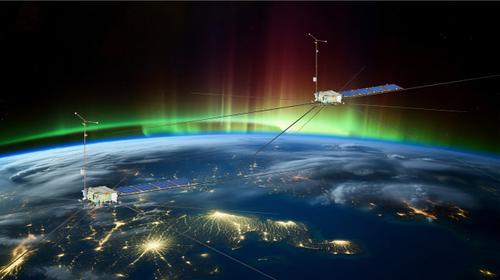
The sensors, developed at NNGU, have a record low level of intrinsic noise - an order of magnitude lower than natural background values. This allows even weak changes in the magnetic field caused by natural or man-made factors to be recorded. The equipment is integrated into a complex of instruments that monitor ionospheric disturbances, ozone distribution, and radiation conditions.
A series of experiments will start in May 2025 as part of the "Ionozond-2025" project. Scientists plan to study the dynamics of ionospheric processes and their relationship with space weather. This will involve not only satellites, but also the "SURA" ground-based radar complex, which is capable of artificially creating disturbances in the upper atmosphere. According to university representatives, two more similar devices will be sent into orbit in the summer, which will increase the detail of observations.
Read more materials on the topic:
"Space Weather News": flight tests of the "Ionosphere-M" satellites have been completed
"Ionosphere-M" satellites have collected unique information about space weather
Never miss our newsAdd this site to your preferred sources to see us more oftenAdd on Google

















