Over the past Thursday, May 14, 2025, four class M flares and one class X2.5 flare occurred on the Sun.
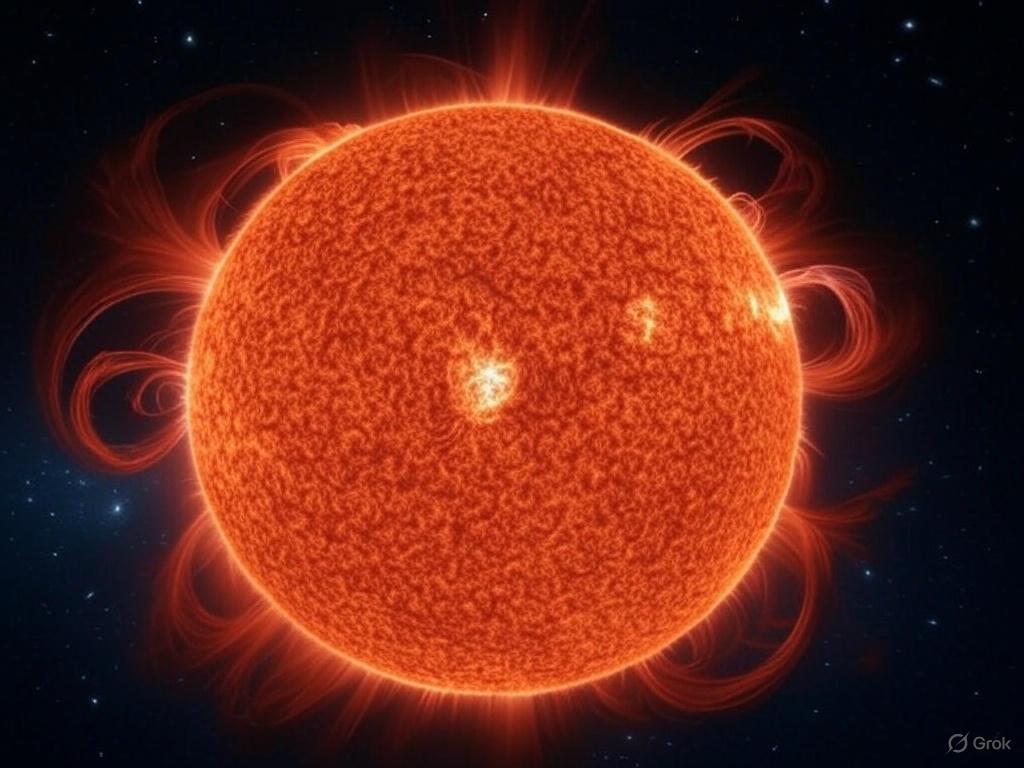
At 21:11 Moscow time, an M4.7 class flare occurred in the active region of the Sun with coordinates N17E60, lasting 29 minutes. This is the fourth case of a flare of similar power in the current day.
Earlier on Wednesday, the same area of the solar surface generated three other class M flares - M5.3, M1.2 and M7.7, as well as one extreme class X2.5 flare.
Solar flares are classified according to the intensity of X-ray radiation reaching Earth's orbit. The scale includes five categories: from a minimum of A0.0 (10 nanowatts/m²) to a maximum of X, where each subsequent class is ten times more powerful than the previous one. Powerful energy emissions are often accompanied by coronal mass ejections - clouds of charged particles which, when reaching our planet, cause geomagnetic storms.
If the ejected plasma cloud collides with the Earth's magnetosphere, magnetic storms of level G3-G4 may begin in the coming days. Strong magnetic storms can disrupt navigation, cause failures in radio transmissions, and even damage transformers.
According to current forecasts from geophysicists, powerful magnetic storms are not expected. The bulk of the solar matter is moving towards Mars, located at an angle of about 70 degrees to the Sun-Earth line. The Red Planet is likely to collide with a stream of plasma in the coming days. On Earth, the geomagnetic situation remains stable - the forecast maintains a "green" level. Minor fluctuations are associated with the natural dynamics of the solar wind, and not with the latest flares.
Read more on the topic:
Several magnetic storms are expected on Earth in May 2025: forecast by Russian astronomers
The Sun is "storming": a flare of the penultimate power class was registered on May 14
Less than a day has passed: the most powerful flare this year occurred on the Sun on May 14
Never miss our newsAdd this site to your preferred sources to see us more oftenAdd on Google

















