ITMO scientists have developed a new family of metal-organic crystals capable of spontaneously transitioning from a 3D structure to 2D. These ultrathin materials (from 4 nanometers) can be used to create energy-efficient memristors and ReRAM technology, designed for recording and storing data.
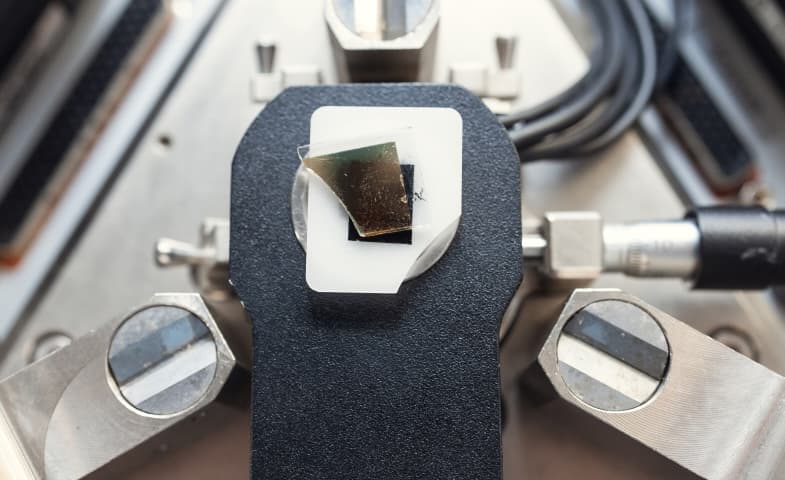
The main advantage of the method is the absence of the need for expensive lithography, which reduces production costs. The new process involves heating a solution of organic compounds and zinc salts, after which 3D crystals are formed. Then, drying in the air, they spontaneously transform into 2D structures. This simplifies the production of thin layers with improved electronic properties.
The finished 2D crystals can be used in microoptics and computing devices, including memory elements for artificial intelligence systems. They are energy-independent, allow selective access to individual memory cells, and operate on neuromorphic principles, mimicking the activity of brain neurons.
The resulting 2D crystals retain information for more than 2 hours and withstand over 100 conductivity switching cycles.
Read materials on the topic:
FEFU Creates New Method for Information Storage Using Nickel Nanostructures
Now on home

Start of deliveries scheduled for 2027

Over 51,000 new motorcycles were sold in Russia in 2025

The car will take at least a year to assemble

The application's audience has reached 20 million users

The model will be included in the list of cars for taxis, price - from 2.25 million rubles

All parking lots of the "Administrator of the Moscow Parking Space" are connected to the service

The cars will be supplied to the Moscow Transport Service Directorate

Deliveries to India may begin in 2028

The technology provides automated search for all types of defects in power units

The plane flew 500 km, accelerating to 425 km/h

The plant stated that the information about the termination of purchases for models 6 and 8 is not true

Scientists are using the "Ekran-M" installation