Researchers from NUST MISIS and their commercial partners have announced the launch of a three-dimensional bioprinting technology that allows scanning damaged tissues and organs and restoring them "on site".
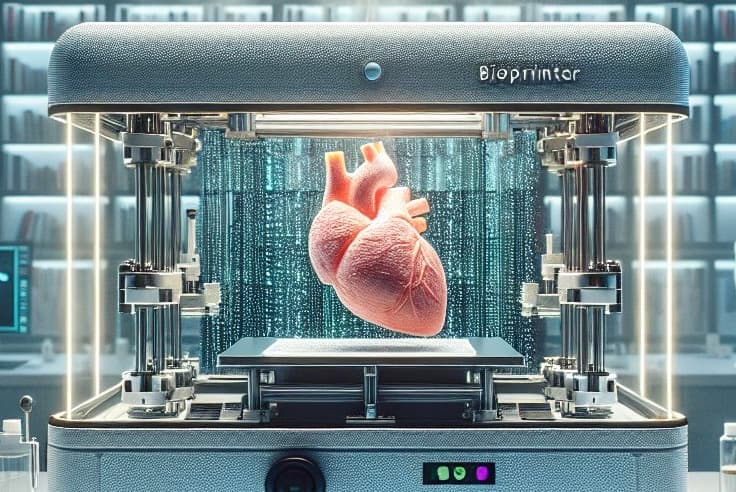
The device scans the defect, creates its three-dimensional map, and performs bioprinting along a given trajectory. This takes only five minutes. The device adapts to the patient's breathing and is compatible with various hydrogels, and its functionality can also be used as a classic 3D printer.
The created systems allow closing damaged areas of the skin and organs with polymer compositions containing the patient's own cells and biomolecules. Laboratory tests have shown that the use of bioprinting techniques significantly accelerates tissue healing and reduces the risk of postoperative complications.
A year ago, the technology was successfully used in the world's first operation, when specialists from the Burdenko Main Military Clinical Hospital restored the structure of an organ using a robotic arm, a computer vision system, and bioprinting based on the patient's bone marrow cells.
The device has already been launched on the commercial market. Researchers continue to improve the three-dimensional bioprinting system in collaboration with Sechenov and Samara State Medical Universities.
Read materials on the topic:
Первая в мире операция с биопечатью прямо на пациенте проведена в России: подробности и перспективы
Напечатают почки, печень и щитовидную железу: Росатом освоит технологию биопечати к 2030 году
Кровеносные сосуды, желудок, кишечник: космонавты на МКС начнут печатать человеческие органы
Now on home

Start of deliveries scheduled for 2027

Over 51,000 new motorcycles were sold in Russia in 2025

The car will take at least a year to assemble

The application's audience has reached 20 million users

The model will be included in the list of cars for taxis, price - from 2.25 million rubles

All parking lots of the "Administrator of the Moscow Parking Space" are connected to the service

The cars will be supplied to the Moscow Transport Service Directorate

Deliveries to India may begin in 2028

The technology provides automated search for all types of defects in power units

The plane flew 500 km, accelerating to 425 km/h

The plant stated that the information about the termination of purchases for models 6 and 8 is not true

Scientists are using the "Ekran-M" installation