In Novosibirsk, tests have begun on an electromagnetic calorimeter for the MPD multipurpose detector, which will be used at the NICA collider being built in Dubna. These tests are conducted by scientists from the Institute of Nuclear Physics of the Siberian Branch of the Russian Academy of Sciences in collaboration with the Joint Institute for Nuclear Research (JINR).
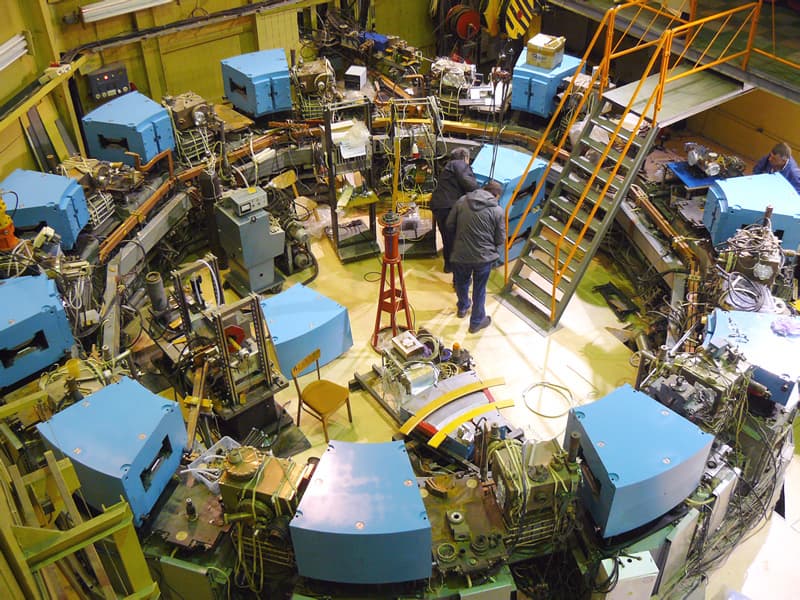
The electromagnetic calorimeter is tested using a test electron beam, which makes it possible to simulate the operating conditions of the collider at high energies. One of the goals of the tests is to determine the limit of the calorimeter's linearity - its ability to accurately measure the energy of particles depending on their energy. This is a crucial parameter, since the NICA collider will operate at energies requiring high measurement accuracy.
The calorimeter consists of many cells, called towers, each of which consists of 210 layers of a substance that emits light when interacting with ionizing radiation. In the future, several tens of thousands of such cells will be installed on the collider detector, which may vary in size, shape, and coating quality. Each element of the calorimeter is directed to the point of ion collision, which requires bringing them to a single standard. This is why preliminary testing is necessary.
The tests are carried out on the Novosibirsk collider VEPP-4M, which is one of the few places in Russia where it is possible to generate electron beams with the required characteristics for testing detectors. According to Yuri Krechetov, a leading researcher at JINR, the main goal of these tests is to obtain an important result that will determine the limit of the calorimeter's linearity at high energies.
NICA (Nuclotron based Ion Collider fAcility) is an accelerator complex being created in Dubna to study the properties of dense baryonic matter. An important task of NICA is to recreate the quark-gluon plasma, one of the first states of matter that existed in the early Universe, just a few ten-thousandths of a second after the Big Bang. This process will require the creation of high-precision measuring instruments, one of which is the calorimeter being tested.
Read related materials:
Unique central magnet-solenoid for the NICA collider in Dubna was cooled to minus 268.15°C
Russian NICA collider to receive new research detector
World-class discoveries: Putin explained the potential of the collider near Moscow
Now on home

Start of deliveries scheduled for 2027

Over 51,000 new motorcycles were sold in Russia in 2025

The car will take at least a year to assemble

The application's audience has reached 20 million users

The model will be included in the list of cars for taxis, price - from 2.25 million rubles

All parking lots of the "Administrator of the Moscow Parking Space" are connected to the service

The cars will be supplied to the Moscow Transport Service Directorate

Deliveries to India may begin in 2028

The technology provides automated search for all types of defects in power units

The plane flew 500 km, accelerating to 425 km/h

The plant stated that the information about the termination of purchases for models 6 and 8 is not true

Scientists are using the "Ekran-M" installation