Specialists from the Joint Institute for Nuclear Research (JINR) have successfully cooled the MPD solenoid (central magnet), a key component of the NICA collider being created, to operating temperatures. This was reported by the institute's press service.
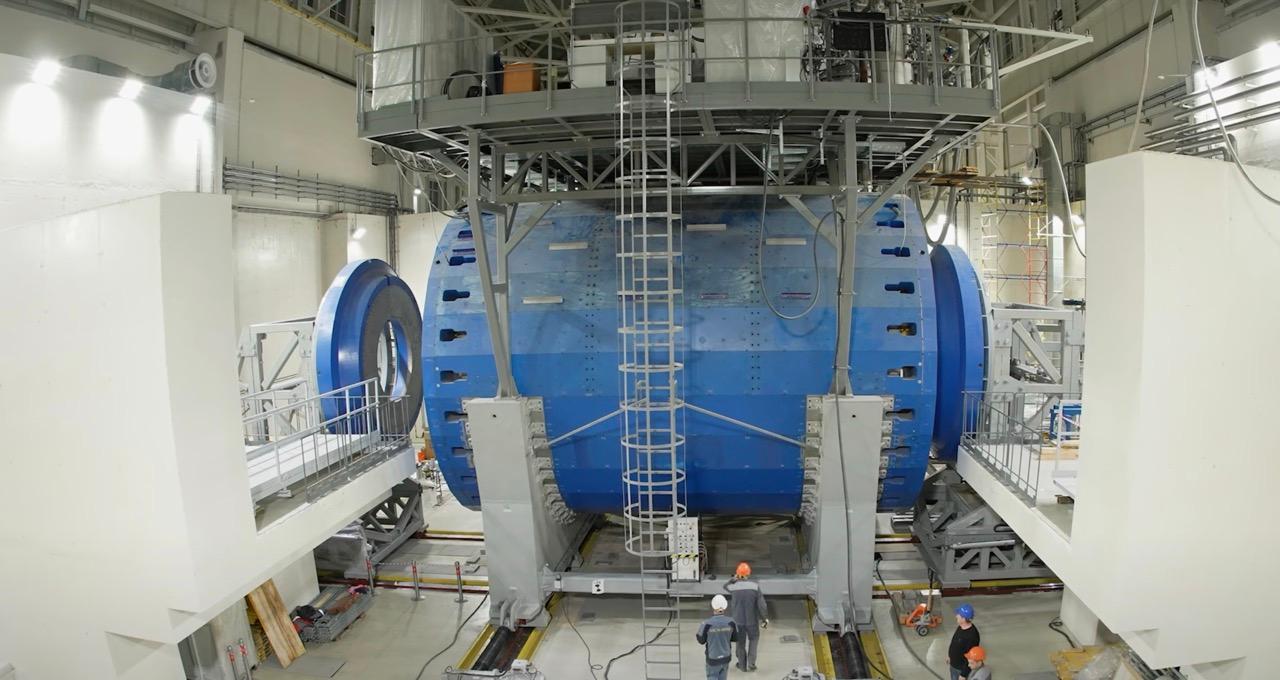
The solenoid was cooled to a temperature of 4.5-5 Kelvin (minus 268.65 - minus 268.15°C) along the entire length of the superconducting coil. This achievement confirmed the absence of cold leaks and demonstrated the quality of the developed cooling scheme and hydraulic system.
The superconducting solenoid, a giant cylindrical magnet about 6 meters in diameter and about 9 meters long, is the central node of the MPD multipurpose detector. The unique design ensures high uniformity of the magnetic field in the detector's working volume with a deviation of no more than 1/10,000, which ensures high-quality data for scientific research.
The solenoid has been cooled to operating temperature for the first time since its creation. This is necessary for the transition to superconducting mode. The successful completion of this stage confirms the high quality of the magnet's manufacture and paves the way for the completion of the MPD detector assembly and the start of the collider's operation.
Konstantin Mukhin, Deputy Chief Engineer of the Laboratory of High Energy Physics (LHEP) at JINR, reported that the preparation of the unit, which began last winter, involved overcoming many difficulties. In particular, the cryogenic system was assembled without the participation of Western manufacturers, which required the development of new software.
At the end of December, the solenoid will be temporarily heated, and from February 2025, its re-cooling to 4.5 Kelvin will begin. After that, LHEP specialists will measure the magnetic field map of the solenoid, which will take about two and a half months. Then the assembly of the MPD detector systems will begin.
Read more on the topic:
Russian NICA collider to receive new research detector
World-class discoveries: Putin explained the potential of the collider near Moscow
Never miss our newsAdd this site to your preferred sources to see us more oftenAdd on Google

















