Translated with AI from the Russian original.
Russia has developed anti-drone shelters for helicopters and airplanes. They consist of cable sections and steel folding arches that can withstand even a fairly large strike drone.
Such shelters will be able to protect against small tactical kamikaze drones and minimize damage in the event of an attack by more powerful machines. The protective structure for helicopters is a folding hemisphere with a diameter of 16 m.
This solution allows you to land a helicopter in the center of the shelter, and then unfold a cable structure over it. It consists of a cable net and a rigid frame made of a steel square tube. The size of the cell side of such a net is from 50 to 180 mm.
There is also a simpler shelter option - using a cable net and eight poles, a rectangular shelter is constructed at the airfield with a height of 9 m, a width of 26 m and a length of 32 m.
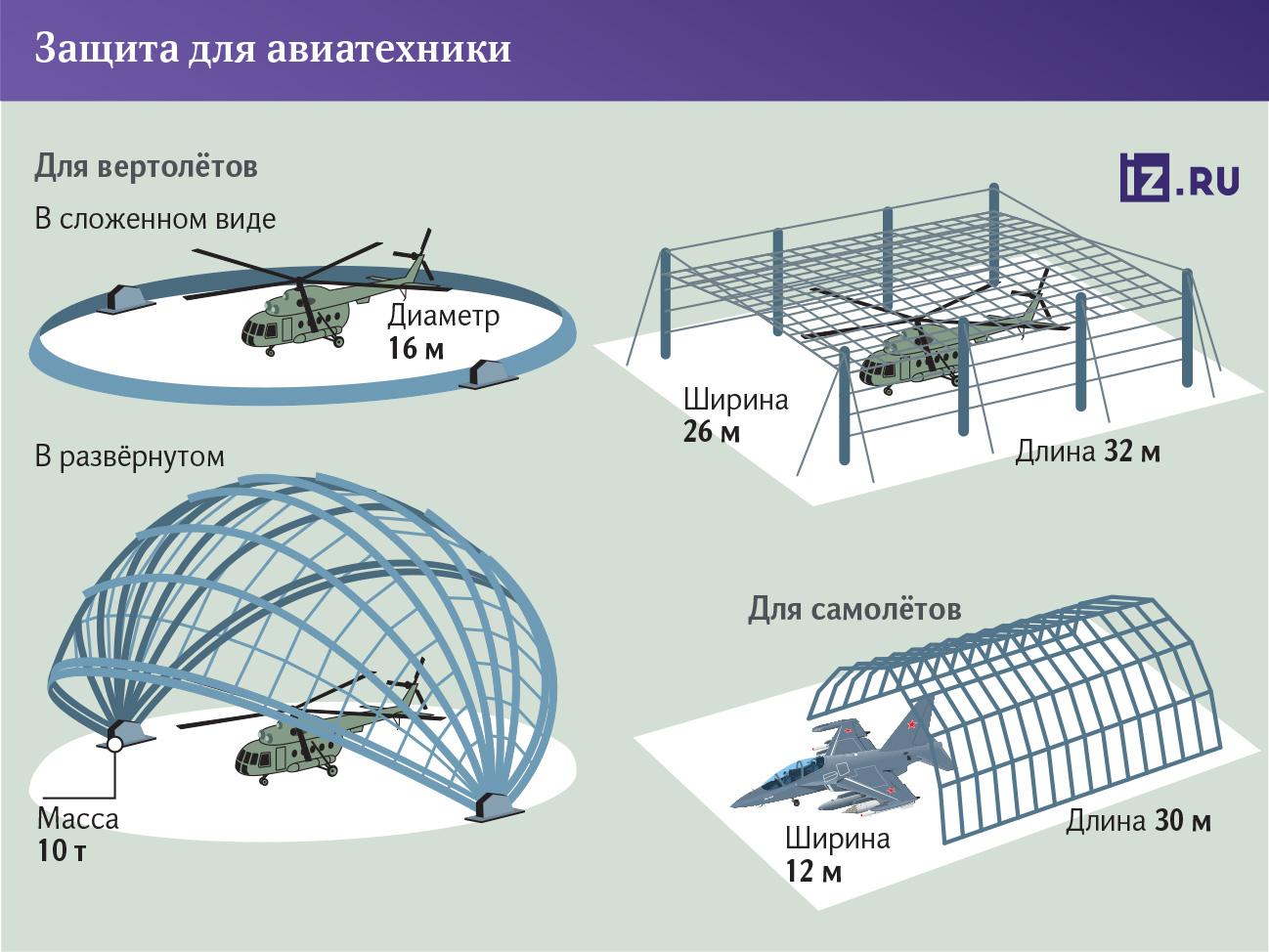
The cable net protects aircraft from all sides. One of the sides from which aircraft will be rolled in is a folding canopy made of cable netting. The developer states that both designs can protect a Mi-8 helicopter from enemy UAVs. In this case, the less bulky Mi-28 and Ka-52 will also easily fit into the shelter.
Earlier www1.ru reported that an important feature of the Su-57 fighters will allow to detect Storm Shadow even at hypersonic speeds.
Read related materials:
Eyes of Russian artillery: Zala scouts invulnerable to electronic warfare became the main assistants of assault troops
Expert explained how Russia can protect itself from stealthy British SPEAR-3 missiles
The newest missile ship "Tucha" with "Caliber" and "Pantsir-ME" will join the Russian Navy
Never miss our newsAdd this site to your preferred sources to see us more oftenAdd on Google

















